The grain moth life cycle explains how tiny moths develop from eggs into larvae, pupae, and adults inside or around stored grains. The term grain moth is often used for moth pests that attack stored cereals, especially the Angoumois grain moth (Sitotroga cerealella) and the Indianmeal moth (Plodia interpunctella). These moths are important because their larvae damage grain, contaminate food, and create webbing, holes, dust, and unpleasant storage conditions.
In real storage environments, grain moth larvae cause the most damage. Adult moths mainly fly, mate, and lay eggs. In the Angoumois grain moth, the larva usually bores into a single kernel and feeds inside it. In the Indianmeal moth, larvae often feed on broken grain, flour, cereal, nuts, dried fruits, birdseed, pet food, and other pantry products.
The full life cycle can be completed in about 30 days under warm, favorable conditions for Angoumois grain moth, while Indianmeal moth often completes development in about 6–8 weeks under suitable conditions. Temperature, humidity, food quality, and storage hygiene strongly affect their development.
Q: What is the grain moth life cycle?
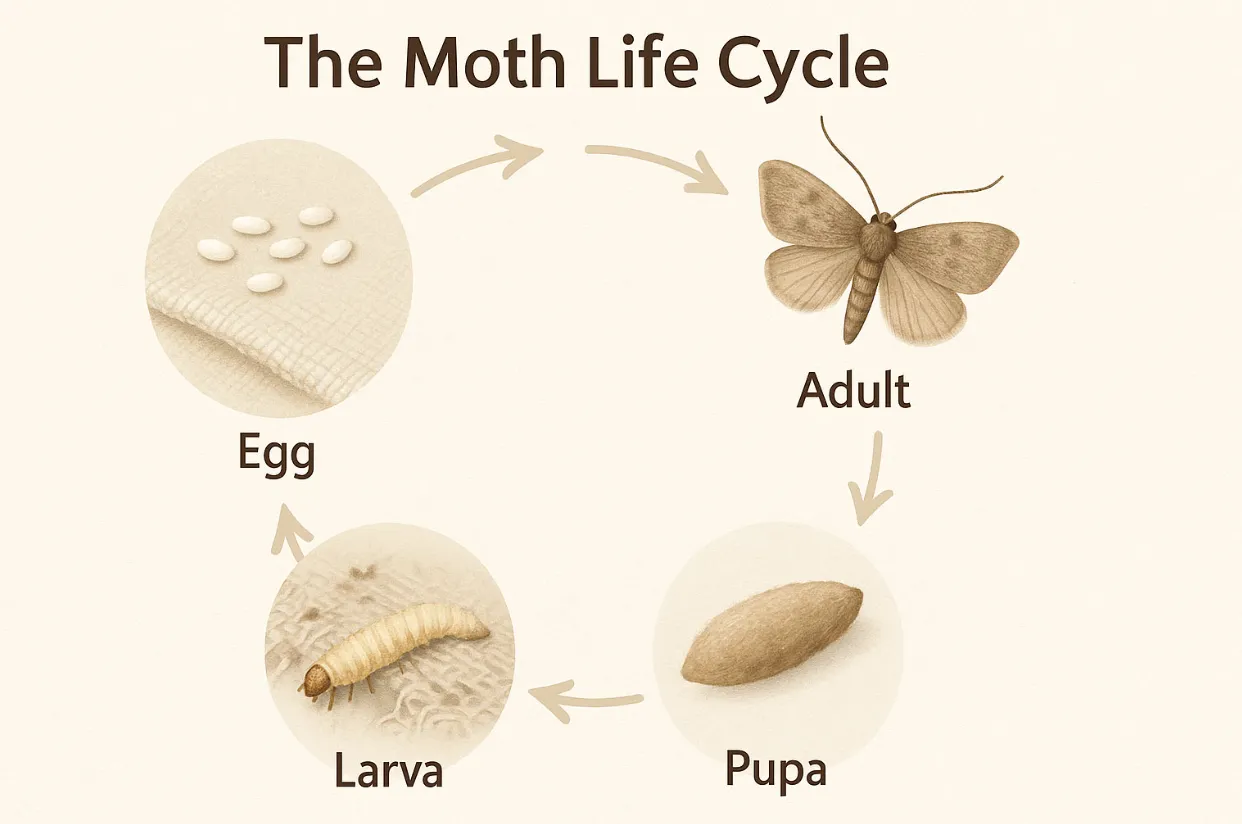
A: The grain moth life cycle has four stages: egg, larva, pupa, and adult.
Q: Which stage damages grain the most?
A: The larval stage causes the main damage by feeding inside kernels or on stored food materials.
Q: How fast can grain moths multiply?
A: In warm storage areas, some grain moths can complete a generation in about one to two months, allowing repeated infestations if food remains available.
Quick Life Cycle Table
| Stage | What Happens | Common Duration | Main Sign |
| Egg | Female moth lays eggs on or near grain/food | 2–14 days for Indianmeal moth; varies by species | Tiny eggs are hard to see |
| Larva | Caterpillar feeds on kernels, grain dust, cereal, or pantry food | Around 4–5 weeks for Indianmeal moth; Angoumois larvae feed inside kernels | Webbing, holes, hollow kernels, clumped food |
| Pupa | Mature larva changes into an adult moth inside a cocoon or kernel | Around 2 weeks for Indianmeal moth | Cocoon in cracks, shelves, grain mass, or kernel |
| Adult | Moth emerges, mates, and lays eggs | Often about 1–2 weeks, depending on the species | Small moths flying near the grain or the pantry |
The History of Their Scientific Naming, Evolution, and Origin
Scientific Naming of Grain Moths
The most important stored-grain species associated with the keyword ‘grain moth‘ is the Angoumois grain moth, scientifically known as Sitotroga cerealella. The name is connected with cereal-feeding behavior because this moth is strongly associated with grains such as corn, wheat, rice, sorghum, barley, and oats.
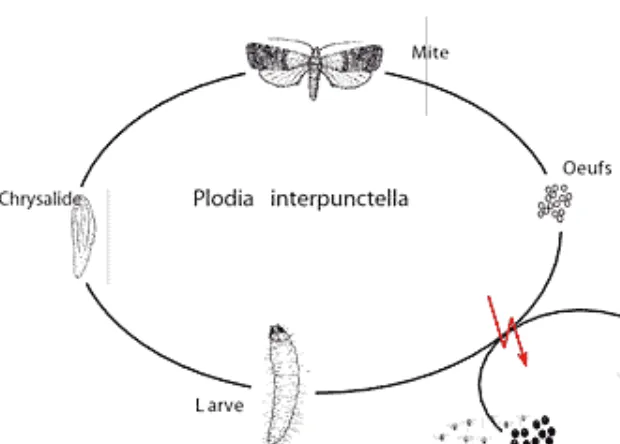
Another commonly confused species is the Indian meal moth, scientifically known as Plodia interpunctella. It is more common in household pantries and attacks a wider range of dry foods, including cereals, flour, nuts, spices, dried fruits, pet food, and birdseed.
Evolution and Stored-Grain Adaptation
Grain moths evolved as part of natural ecosystems where moth larvae fed on seeds, plant materials, and dry organic matter. Human agriculture created large, stable food stores, giving these insects ideal places to reproduce.
Over time, species like the Angoumois grain moth became highly adapted to stored cereals. Its larvae can enter kernels and complete development within the grain, thereby protecting them from many surface-level threats. This internal feeding habit makes infestations difficult to detect early.
Origin and Global Spread
Grain moths spread widely through trade, grain movement, storage facilities, farms, mills, warehouses, and household food packaging. Today, stored-grain moths are found in many regions where cereals are grown, stored, transported, or processed.
Their Reproductive Process, Giving Birth And Rising Their Children
Mating After Adult Emergence
Adult grain moths emerge from pupae with one main biological purpose: reproduction. They are not parental insects like birds or mammals. After emergence, males search for females, usually guided by chemical signals called pheromones.
In storage areas, adult moths may fly at dusk or during low-light periods. This behavior helps them find mates and suitable egg-laying sites around grain, shelves, bins, cracks, sacks, or food packages.
Egg Laying on or Near Food
Female grain moths lay eggs directly on or near suitable food sources. In the Angoumois grain moth, eggs may be laid between kernels, and the newly hatched larvae quickly bore into the grain. In Indianmeal moth, females can lay hundreds of eggs on stored food materials, and larvae begin feeding soon after hatching.
No Parental Care
Grain moths do not “raise” their young in the way mammals or birds do. Their strategy differs: females lay eggs where larvae can immediately access food.
Once the eggs hatch, the larvae survive by feeding, hiding, and developing in protected areas. For the Angoumois grain moth, the kernel itself becomes both food and shelter. For Indianmeal moth, webbing and food fragments create a feeding zone.
High Reproductive Potential
The reproductive success of grain moths depends on temperature, moisture, and food availability. In warm storage conditions, generations can overlap, meaning eggs, larvae, pupae, and adults may all be present simultaneously. This is why a single small-grain moth infestation can quickly become a serious storage problem.
Stages of Grain Moth Life Cycle
1. Egg Stage
The egg stage begins when a female lays eggs on or near stored grain or dry food. These eggs are very small and often go unnoticed during routine inspection.
In warm conditions, eggs hatch faster. For Indianmeal moth, eggs can hatch in 2–14 days, while Angoumois grain moth development also depends strongly on temperature and humidity.
2. Larval Stage
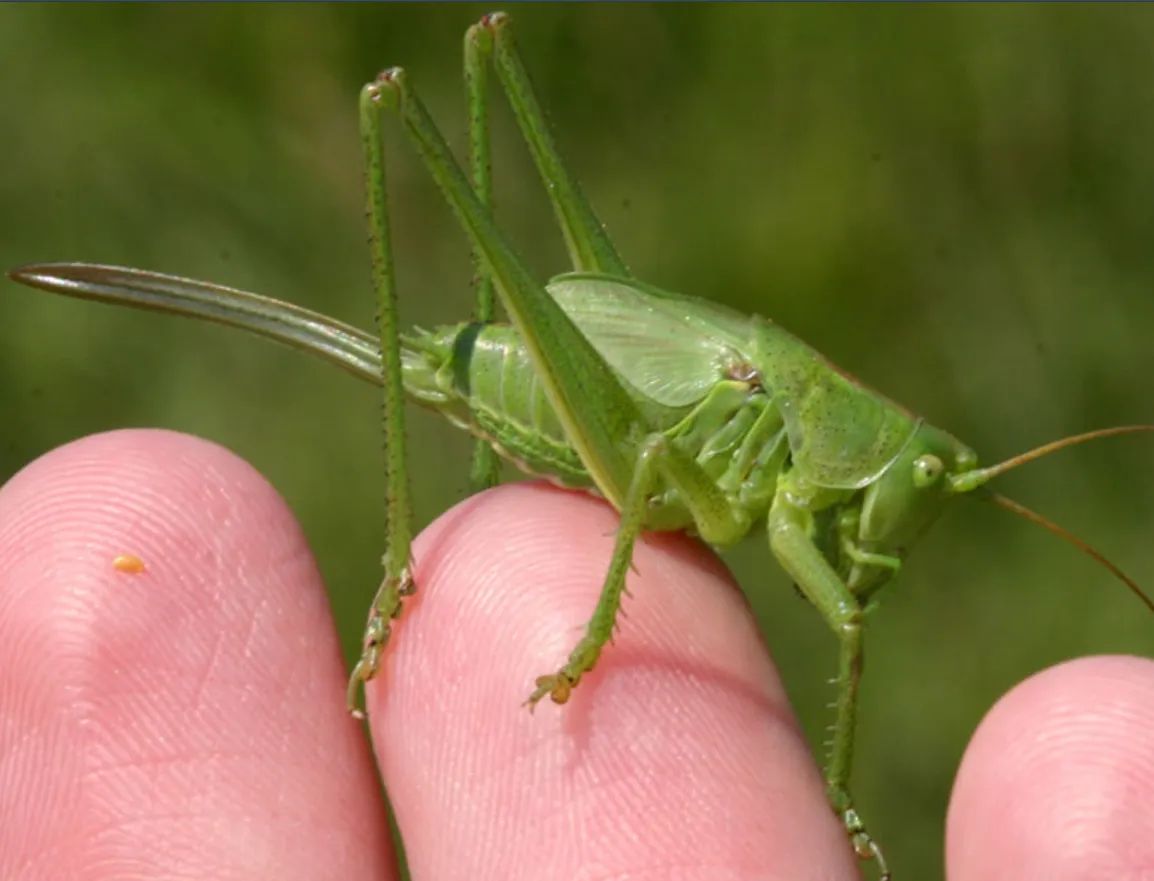
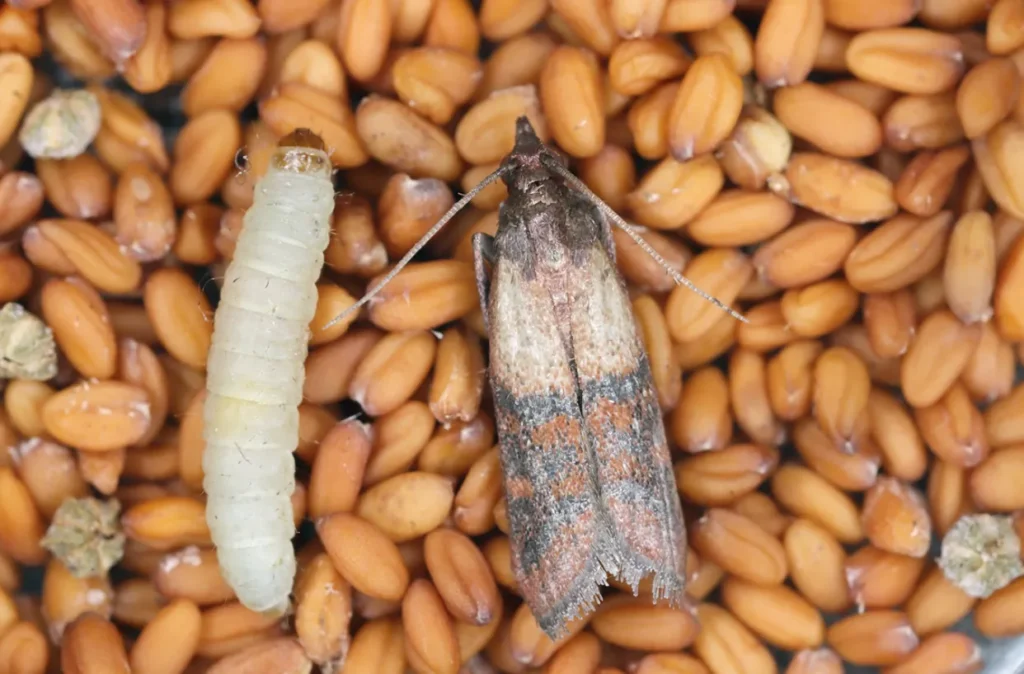
The larval stage is the most destructive stage of the grain moth life cycle. These larvae are small caterpillars, not worms, even though people often describe them as such.
Angoumois grain moth larvae bore into kernels and feed inside. A damaged kernel may become hollow, with a round exit hole visible when the adult emerges. The University of Kentucky notes that an infested kernel may weigh about 20% less than a sound kernel.
3. Pupal Stage
After feeding, the larva becomes a pupa. This is the transformation stage, during which the insect changes from a caterpillar into an adult moth.
Indianmeal moth larvae may leave the food source and pupate in cracks, corners, walls, ceilings, shelves, or packaging folds. Angoumois grain moth may pupate inside the kernel before the adult exits through a circular hole.
4. Adult Stage
The adult moth is the flying stage. Adults are usually small, fragile, and short-lived. Their main role is to mate and lay eggs.
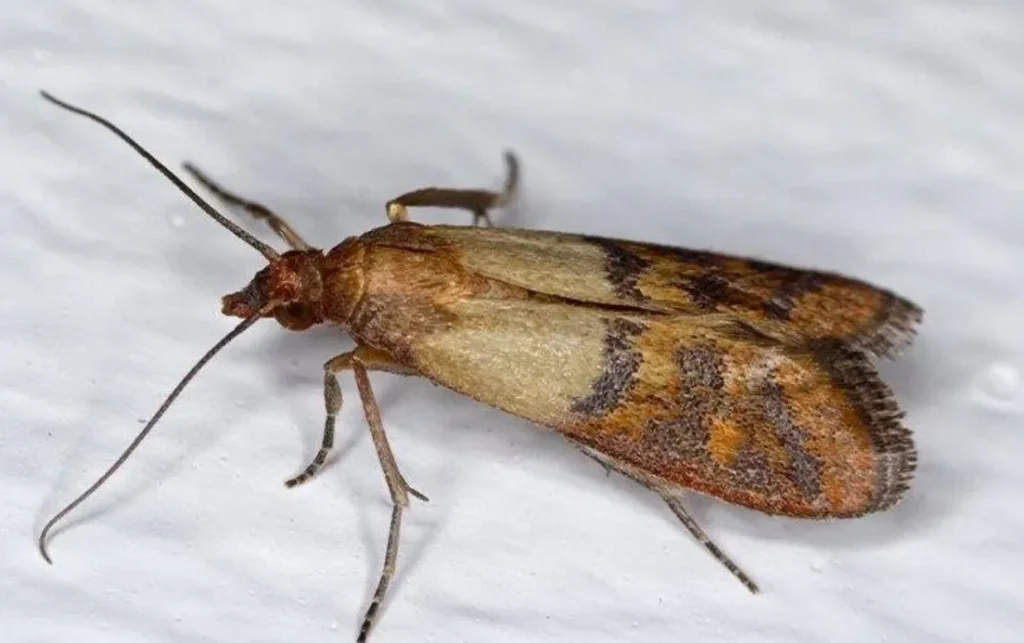
Adult Angoumois grain moths are small tan-to-gray moths with fringed wings. Adult Indianmeal moths have distinctive wings with a grayish inner section and a coppery outer section. Adult moths themselves do not cause the main feeding damage; the larvae do.
Their main diet, food sources, and collection process are explained
The diet of grain moths depends on the species and the storage environment. The most damaging feeding stage is always the larva.
Main Diet
Angoumois grain moth larvae mainly feed inside whole cereal kernels. They are known as primary stored-grain pests because they can attack intact kernels. Their common food sources include corn, wheat, rice, sorghum, barley, and oats.
Indianmeal moth larvae are more flexible feeders. They often feed on broken grains, flour, cereal, nuts, dried fruits, seeds, spices, chocolate, birdseed, and dry pet food.
Food Collection Process
Grain moth larvae do not collect food like ants or bees. Instead, the female moth lays eggs near food, and the larvae start feeding after hatching.
For Angoumois grain moth, the larva enters a grain kernel and uses the kernel as a private feeding chamber. For Indianmeal moth, larvae move through food material and produce silk webbing that loosely binds food particles together.
Infestation Signs Around Food
Common food-related signs include:
- Round holes in grain kernels
- Hollow or lightweight kernels
- Silken webbing in cereal or flour
- Clumped grain or food particles
- Small larvae crawling near food
- Adult moths flying around storage areas
Important Things That You Need To Know
Understanding related terms helps identify and manage a grain moth infestation correctly. Not every moth found near food is the same species, and control depends on proper identification.
A grain moth usually refers to a stored-product moth that attacks cereal grains or dry food. The Angoumois grain moth is especially important in stored corn and whole grains because its larvae develop inside kernels. This makes it harder to detect than surface-feeding pests.
Grain moth traps are usually pheromone-based traps used to monitor male moth activity. They help confirm that moths are present, but traps alone may not remove an infestation because they do not capture eggs, larvae, or female moths effectively. Colorado State University notes that pheromone traps are useful for monitoring Indianmeal moths, but are not enough alone for full management.
Grain moth larvae are the real damaging stage. They chew, contaminate, tunnel, and produce webbing or waste. In cases of stored-grain moth problems, larvae may remain hidden within grain masses, food packages, cracks, or kernels.
The term “Indian grain moth” is often used casually, but many people actually mean “Indianmeal moth,” a common pantry pest. It attacks many dry foods and is frequently found in homes, grocery storage areas, warehouses, and food-processing areas.
For any grain moth infestation, the best first step is to identify the food source, remove infested material, clean thoroughly, and store remaining food in tight containers. Freezing suspect food for about a week can help kill eggs and larvae in household situations.
How Long Does A Grain Moth Live
The lifespan of a grain moth depends on species, temperature, humidity, food quality, and storage conditions. Because “grain moth” is a general term, the life duration is best understood by separating the full life cycle from adult lifespan.
- Full life cycle duration varies by species.
- The Angoumois grain moth can complete development in about 30 days at 86°F and about 40 days at 77°F, according to the University of Kentucky Extension. In heated warehouses, repeated generations may occur.
- Indianmeal moth development is often slower.
- The Indianmeal moth can complete its life cycle in about 6–8 weeks under favorable conditions. Eggs hatch in 2–14 days, larvae mature in 4–5 weeks, and pupation lasts about 2 weeks.
- Adult moths live for a short time.
- Adult stored-food moths usually live long enough to mate and lay eggs. Colorado State University notes that adult Indianmeal moths survive about one week because they do not feed.
- Warm storage speeds up the life cycle.
- Grain moths develop faster in warm conditions. If a grain bin, warehouse, kitchen, or pantry remains warm, eggs hatch faster and larvae grow quickly.
- Cold conditions slow development.
- In colder conditions, larvae may become inactive, or development may slow significantly. This is why some infestations appear to “pause” in winter and become active again when temperatures rise.
- Food quality affects survival.
- Whole kernels, cracked grain, flour dust, cereals, nuts, and dry pet food can support larval growth depending on the species. Poor sanitation gives larvae more hidden feeding points.
- A single adult is not the whole problem.
- Seeing one moth may indicate hidden eggs, larvae, or pupae nearby. Adults are only the visible stage; the damaging stage may already be developing inside grain or packaged food.
- Overlapping generations make control harder.
- In warm indoor environments, eggs, larvae, pupae, and adults may coexist. This means cleaning must target all possible food sources, not just visible moths.
Grain Moth Lifespan in the Wild vs. in Captivity
Lifespan in the Wild
In the wild or field environment, grain moths face predators, weather changes, limited food, and seasonal temperature shifts. The Angoumois grain moth can begin infestation in the field when moths lay eggs on exposed kernels, especially where corn shucks are loose or damaged.
Outdoor survival is less predictable. Rain, cold, heat, birds, spiders, parasitoids, and natural food shortages reduce survival. Development may slow during colder months.
Lifespan in Stored Grain or Captive Conditions
In stored grain, warehouses, mills, laboratories, and household pantries, grain moths may live and reproduce more successfully because food is concentrated and shelter is stable.
Warm indoor storage can support multiple generations per year. University of Kentucky reports that Angoumois grain moth may have four to five generations per year, and even more in heated warehouses.
Why Storage Conditions Increase Infestation
Captive-like storage environments protect moths from the weather and provide a continuous food supply. If grain is not inspected, cleaned, dried, sealed, or rotated, moth populations can grow quietly until signs become obvious.
Importance of Grain Moth in this Ecosystem
Part of the Food Web
Although grain moths are pests in homes, farms, and warehouses, they still have ecological roles. Their eggs, larvae, pupae, and adults can serve as food for spiders, predatory insects, parasitoid wasps, birds, and small animals.
Natural Decomposers of Dry Plant Material
In natural settings, moth larvae help break down dry seeds and plant-based organic matter. This contributes to nutrient cycling, although the same behavior becomes economically harmful when it happens in stored grain.
Indicator of Storage Weakness
In human-managed systems, grain moths act as biological warning signs. Their presence often indicates poor storage hygiene, old grain residue, damaged packaging, moisture problems, or unsealed food.
Agricultural and Food-Safety Importance
Grain moths are important because they reduce food quality, contaminate stored products, and increase waste. Indianmeal moth larvae can contaminate pantry foods with webbing, frass, and cast skins, while Angoumois grain moth can hollow out kernels from the inside.
What to do to protect them in nature and save the system for the future
Protect Natural Habitats
- Avoid destroying wild plant areas unnecessarily.
- Natural habitats support predators that help balance moth populations.
- Biodiversity helps prevent one pest species from dominating.
Use Integrated Pest Management
- Use IPM rather than relying solely on chemicals.
- Combine cleaning, monitoring, sealing, drying, temperature control, and proper disposal.
- Use pesticides only according to local rules and label directions.
Reduce Food Waste
- Store grain properly to prevent large infestations.
- Damaged grain means wasted food, money, labor, and farming resources.
- Better storage protects both people and the environment.
Encourage Natural Predators
- Spiders, parasitoids, birds, and predatory insects help control moth populations outdoors.
- Avoid unnecessary pesticide use in natural areas where beneficial organisms live.
Improve Storage Education
- Farmers, warehouse workers, shop owners, and homeowners should learn the early signs of grain moth infestation.
- Early detection reduces the need for harsh control methods and prevents food loss.
Fun & Interesting Facts About Grain Moth Life Cycle
- Grain moth larvae are caterpillars, not worms.
- The Angoumois grain moth can develop inside a single grain kernel, making early infestation hard to notice.
- Adult grain moths are not the main feeding problem; the hidden larvae cause most damage.
- Indianmeal moth larvae can chew through thin cardboard and plastic packaging.
- Pheromone-based grain moth traps mainly catch male moths and are best used for monitoring.
- A grain kernel damaged by Angoumois grain moth may look normal from the outside until the adult moth exits.
- Indianmeal moth larvae can wander far from the food source before pupating.
- Webbing in flour, cereal, or birdseed is one of the clearest signs of stored-food moth activity.
- Warm storage areas can support several generations in a single year.
- Cleaning cracks, corners, shelf edges, and spilled flour is just as important as throwing away infested food.
Frequently Asked Questions (FAQs)
Q: What is the full grain moth life cycle?
A: The full grain moth life cycle includes egg, larva, pupa, and adult. The larva is the main damaging stage.
Q: What do grain moth larvae look like?
A: Grain moth larvae are small caterpillars. They may appear cream, yellowish, pinkish, or light green, depending on the species and diet.
Q: Do grain moth traps remove infestations completely?
A: Usually no. Grain moth traps help monitor adult male moths, but they do not remove eggs, larvae, pupae, or female moths. Cleaning and food-source removal are still needed.
Q: What is the difference between Angoumois grain moth and Indianmeal moth?
A: The Angoumois grain moth often develops inside whole kernels, while the Indianmeal moth commonly feeds on broken grain, flour, cereals, dried fruits, nuts, pet food, and birdseed.
Q: How do I stop a stored grain moth infestation?
A: Find the source, remove infested food or grain, vacuum cracks and corners, wash shelves, store food in airtight containers, and use traps for monitoring. For household food, freezing suspect items for about a week can help kill eggs and larvae.
Conclusion
The grain moth life cycle is simple in structure but powerful in impact. From tiny eggs to hidden larvae, protective pupae, and flying adults, each stage helps the insect survive in stored-grain and dry-food environments. The most important fact is that grain moth larvae cause real damage, whether they feed inside kernels like the Angoumois grain moth or web through pantry foods like the Indianmeal moth.
A successful control plan begins with correct identification, early inspection, clean storage, airtight containers, and proper monitoring with grain moth traps. At the same time, grain moths should be understood as part of nature’s wider food web. They become serious pests mainly when human storage systems give them unlimited food and shelter. By improving storage hygiene and using balanced pest management, we can protect food quality, reduce waste, and maintain a healthier ecosystem.
Also Read: cheetah life cycle