Enterobiasis is a common intestinal parasitic infection caused by Enterobius vermicularis, better known as the human pinworm. It is not a large or dramatic parasite, but its life cycle is highly effective. The worm survives because it uses a simple route: eggs move from the anal area to hands, clothes, bedding, surfaces, or food, then enter the mouth and hatch inside the intestine.
The life cycle of enterobiasis is important because most reinfections occur through the same daily habits that spread the eggs. Children are most often affected, but adults, caregivers, families, and people in shared living spaces can also get infected.
The main sign is itching around the anus, especially at night, although many people have no symptoms at all. Pinworm infection is preventable and treatable, but medicine alone is not always enough. Handwashing, clean bedding, short nails, and household hygiene are key to stopping the spread.
Q: What is enterobiasis?
A: Enterobiasis is a human intestinal infection caused by the pinworm Enterobius vermicularis. It is also called oxyuriasis or pinworm infection.
Q: What are the most common enterobiasis symptoms?
A: The most common symptom is itching around the anus, often worse at night. Some people may also have poor sleep, restlessness, abdominal discomfort, or irritation near the vaginal area.
Q: What is the usual enterobiasis treatment?
A: Common medicines include mebendazole, pyrantel pamoate, or albendazole. Treatment usually includes a second dose two weeks after the first because the medicines kill worms but not eggs.
Important Things That You Need To Know
Before studying the life cycle of enterobiasis, it is helpful to understand key search terms related to this infection. These terms are often used by patients, parents, students, medical coders, and health writers.
Enterobiasis refers to infection with Enterobius vermicularis, a small, white, roundworm that lives mainly in the human intestine. It spreads easily because the eggs are tiny, sticky, and can move from skin to hands, clothes, bedsheets, toys, bathroom surfaces, and other shared objects.
Enterobiasis symptoms are often mild. In fact, many people do not notice anything. When symptoms appear, anal itching at night is the classic sign. The itching happens because female worms leave the intestine at night and lay eggs around the anus. Repeated scratching may irritate the skin and sometimes lead to bacterial skin infection.
What is enterobiasis is a common question because people often know the word “pinworm” but not the medical name. In simple terms, it is a pinworm infection that mainly affects children but can spread within households and childcare settings.
Enterobiasis treatment is usually simple, but hygiene is just as important as medicine. The second dose is important because eggs may survive the first treatment period and later hatch.
Enterobiasis ICD 10 coding is also important in clinical records. The ICD-10-CM diagnosis code for enterobiasis is B80, which includes pinworm infection, threadworm infection, and oxyuriasis.
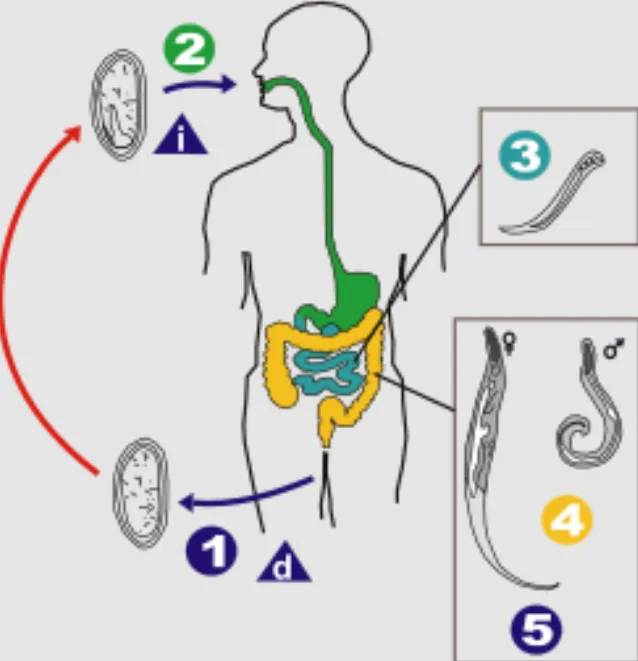
Quick Life Cycle Table
| Life cycle stage | What happens | Why it matters |
| Egg laying | Female Enterobius vermicularis moves out at night and lays eggs around the anus. | This causes itching and starts to spread |
| The egg becomes infective | Eggs become capable of infection within a few hours under good conditions | Infection can spread quickly in homes |
| Egg transfer | Eggs move to fingers, nails, bedding, clothes, toys, towels, or surfaces | This supports reinfection and household spread |
| Egg ingestion | A person swallows infective eggs from hands, food, dust, or objects | This begins a new infection |
| Larvae hatch | Larvae hatch in the small intestine after eggs are swallowed | The parasite enters its active growth stage |
| Adult worms develop | Adults settle mainly in the colon, often near the cecum | The worm matures and prepares to reproduce |
| Female migration | Mature females travel out through the anus at night | This creates itching and fresh egg contamination |
| Repeat cycle | Eggs return to the mouth through poor hygiene or contaminated objects | Reinfection keeps the infection going |
The History of Their Scientific Naming
The scientific naming of Enterobius vermicularis reflects both its shape and its place in the human body.
• The word Enterobius comes from ideas linked with the intestine. This is fitting because the adult worm lives in the human gut, especially the large intestine.
• The word vermicularis comes from a Latin root meaning wormlike. It points to the small, thin, threadlike body of the parasite.
• The common name pinworm comes from the female worm’s pointed tail.
• In some places, it is also called seatworm or threadworm.
• Older terms include oxyuriasis, which is still sometimes used for the disease.
• The name Enterobius gregorii has been proposed for another human pinworm form, but many experts consider it closely related to immature forms of E. vermicularis.
So, the scientific name is not random. It tells us that this is a small wormlike intestinal parasite with a body shape and life cycle closely tied to humans.
Their Evolution And Their Origin
The origin of Enterobius vermicularis is closely connected to the history of humans and other primates. Pinworms are not new parasites. They belong to a broader group of nematodes that developed long before modern human society.
Scientists have studied pinworms in primates to understand how these parasites evolved. Research suggests that pinworms and primates may have changed together over time. This pattern is called coevolution. In simple language, as primate hosts changed, their pinworm parasites also changed.
This does not mean that human pinworms came from modern monkeys or apes in a simple, direct way. Evolution is more complex. It means that the ancestors of these worms likely adapted to the intestines, behaviors, and social lives of primates over a long period of time.
The success of enterobiasis depends on human behavior. People sleep indoors, share bedding, touch surfaces, scratch itchy skin, prepare food, and care for children. These habits give pinworm eggs many chances to move from one person to another.
Modern life has not removed the parasite. In fact, schools, daycare centers, crowded homes, and shared institutions can support its spread. The worm does not need soil, water, insects, or animal hosts to complete its life cycle.
Humans are the main natural host, and the full cycle can continue inside human communities. This makes Enterobius vermicularis a strong example of a parasite shaped by both biology and human social contact.
Their main food and its collection process
The feeding process of Enterobius vermicularis is very different from that of animals that hunt, chew, or gather food. Pinworms do not collect food from nature, as do insects, birds, or mammals. Their food source is inside the human intestine.
• Main feeding area: Adult worms live mainly in the colon and nearby intestinal areas. Mature worms are often found near the ileocecal region.
• Food source: Pinworms feed on materials available in the intestine. This may include bacteria, intestinal contents, and epithelial cells lining the gut.
• No active hunting: The worm does not chase prey. It stays in a nutrient-rich environment and uses its body structure to take in food from the surrounding intestinal area.
• Energy use: The parasite uses this nutrition for growth, molting, mating, egg production, and movement.
• Why the host matters: Because the worm depends on the human intestine, it cannot complete its normal life cycle freely in soil, ponds, plants, or wild habitats.
• Connection to symptoms: Feeding is not usually the main cause of symptoms. The most noticeable symptom comes from female worms migrating at night to lay eggs around the anus.
• Survival strategy: Instead of collecting food in nature, the worm saves energy by living where food is already available.
This feeding style shows why the life cycle of Enterobiasis is so closely linked to humans. The worm’s food, shelter, reproduction, and spread all depend on the human body and human surroundings.
Their life cycle and ability to survive in nature
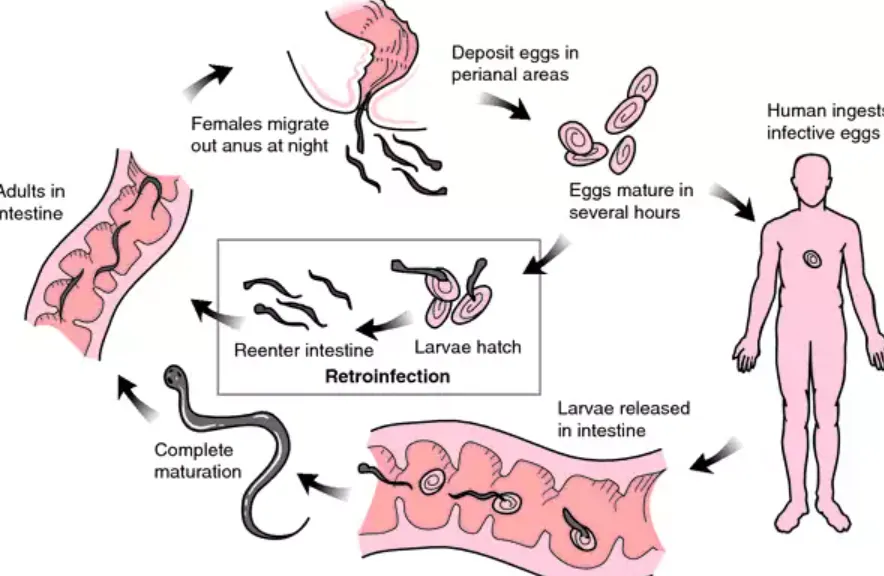
Egg stage around the anus
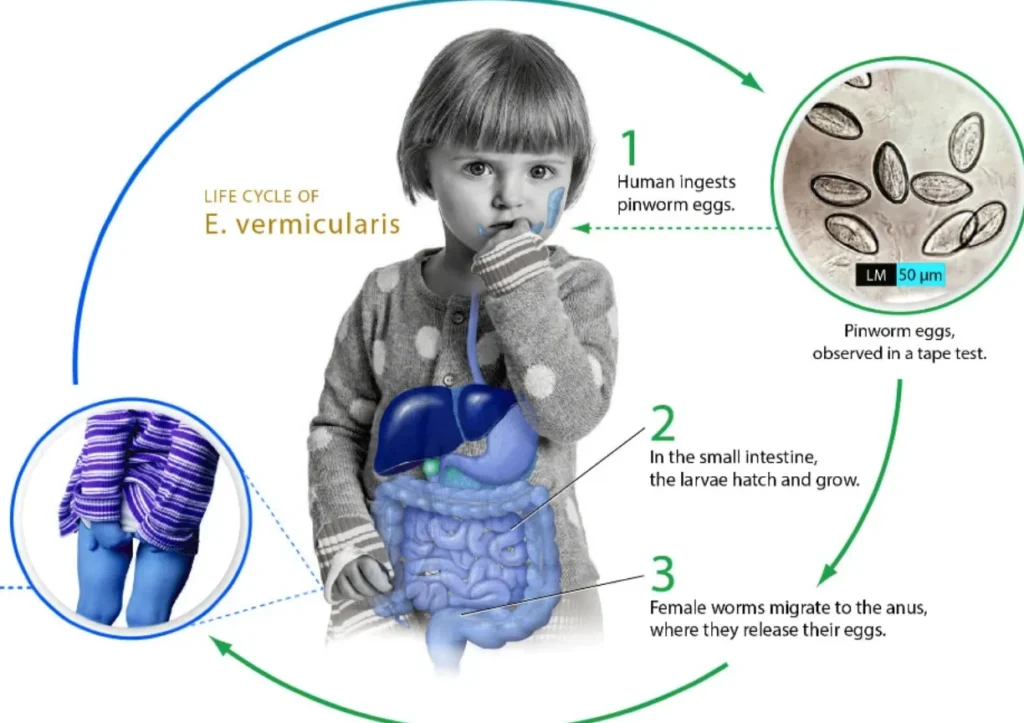
The life cycle begins when a mature female Enterobius vermicularis emerges from the anus at night and lays eggs on the surrounding skin. This movement causes itching, which leads to scratching. Scratching moves eggs to fingers and under nails.
Infection through the mouth
The main route is a hand-to-mouth transfer. A person may swallow eggs after touching contaminated skin, clothes, bedding, toys, towels, toilet seats, or food.
Rarely, a spread can occur when tiny eggs become airborne, are breathed in, and then swallowed.
Hatching and growth
After eggs are swallowed, larvae hatch in the small intestine. The worms mature and move toward the colon.
The time from swallowing infective eggs to egg laying by adult females is about one month. Adult worms may live for about two months.
Survival outside the body
Pinworm eggs do not grow into adult worms in nature. However, they can survive on objects long enough to infect someone else.
Eggs may survive on objects for two to three weeks if they are not properly cleaned.
Why is reinfection common?
The cycle repeats because eggs are sticky, tiny, and easy to spread. Without careful hygiene, the same person or household may become infected again soon after treatment.
Their Reproductive Process and raising their children
The reproductive process of Enterobius vermicularis is simple but very efficient. These worms do not raise their young as birds, mammals, or social insects do. Instead, they produce many eggs and rely on contact, itching, and hygiene gaps to continue the next generation.
• Male and female worms are separate: Adult males are smaller than adult females. Females are usually about eight to thirteen millimeters long, while males are about two to five millimeters long.
• Mating happens inside the intestine: Adult worms mature in the lower digestive tract. Mating occurs inside the host.
• Females carry many eggs: After mating, female worms become full of eggs and prepare to move out of the intestine.
• Night movement is key: The female usually migrates outside the anus at night. This timing increases itching during sleep and helps eggs spread to bedding, fingers, and clothing.
• Egg laying replaces parenting: Pinworms do not feed their young, guard their eggs, or build nests. Their survival strategy depends on producing many eggs.
• Eggs develop quickly: Eggs can become infective in four to six hours under suitable conditions.
• The next generation begins after swallowing: When another person, or the same person, swallows infective eggs, larvae hatch and grow into adults.
This process explains why a single untreated case can affect an entire household. The worm’s reproductive success depends on silent spread, repeated hand contact, and delayed hygiene response.
The importance of them in this Ecosystem
A parasite with a human-centered ecosystem
Enterobius vermicularis is not important to forests, rivers, crops, or wildlife food chains in the way bees, earthworms, fungi, or bacteria are. Its main Ecosystem is the human body and the human living environment.
Role in parasite biology
Pinworm is important because it helps scientists understand host-specific parasitism. It shows how a small organism can depend almost entirely on a single host species and still spread worldwide.
Indicator of hygiene and crowding
Enterobiasis can reflect hygiene behavior, crowding, shared bedding, childcare exposure, and household transmission. It is not a sign of personal failure, but it does show how easily microscopic eggs can move through a social environment.
Medical and public health importance
Pinworm infection is usually mild, but it matters because it affects sleep, comfort, school children, caregivers, and family health. Repeated infections can disrupt daily life and create stress within households.
Not a species to protect
Because enterobiasis is a human parasitic infection, protecting nature does not mean saving pinworms. The goal is to protect people, reduce transmission, improve sanitation, and support healthier human environments.
What to do to protect them in nature and save the system for the future
Since Enterobius vermicularis is a human parasite, the goal is not to protect it in nature. The better goal is to protect human health, protect community hygiene, and prevent unnecessary spread. In this case, saving the system means breaking the infection cycle.
• Wash hands often: Use soap and warm water after using the toilet, after changing diapers, and before handling food.
• Keep fingernails short: Eggs can hide under nails, so short nails reduce the chance of hand-to-mouth spread.
• Avoid scratching: Scratching moves eggs to fingers, bedding, and clothes. Children may need extra help with this.
• Bathe in the morning: Morning bathing helps remove eggs laid overnight around the anus.
• Change underwear and sleepwear daily: This reduces egg buildup on clothing.
• Wash bedding and towels: Clean bedding, towels, underwear, and nightclothes regularly, especially during treatment.
• Clean shared surfaces: Focus on toilet seats, bathroom handles, toys, desks, floors, and other touched surfaces.
• Treat household spread seriously: A healthcare professional may recommend that household members take treatment together because reinfection is common.
• Take the second dose: The second treatment dose is important because common medicines kill worms but do not kill eggs.
• Do not shame infected people: Pinworm spreads easily. Support, hygiene, and treatment work better than embarrassment.
Frequently Asked Questions FAQs
Q: What is enterobiasis in simple words?
A: Enterobiasis is an intestinal infection caused by the human pinworm Enterobius vermicularis. It spreads when tiny eggs are swallowed.
Q: What is the life cycle of enterobiasis?
A: The cycle starts when female worms lay eggs around the anus. Eggs move to hands, clothes, bedding, or surfaces. After being swallowed, they hatch in the small intestine, grow into adults in the colon, mate, and lay eggs again.
Q: What are the main enterobiasis symptoms?
A: The main symptom is itching around the anus, especially at night. Some people may also have disturbed sleep, restlessness, abdominal discomfort, or vaginal irritation. Many people have no symptoms.
Q: How does enterobiasis spread?
A: It spreads mostly by hand-to-mouth contact after touching eggs from the anal area, bedding, clothes, toys, bathroom surfaces, or food. Rarely, eggs may become airborne and then swallowed.
Q: What is enterobiasis treatment?
A: Common treatment options include mebendazole, pyrantel pamoate, and albendazole. A second dose is usually given 2 weeks after the first to kill worms that hatch after the first dose.
Q: What is the enterobiasis ICD 10 code?
A: The ICD-10-CM code for enterobiasis is B80. It includes enterobiasis, oxyuriasis, pinworm infection, and threadworm infection.
Q: Can pinworm eggs survive outside the body?
A: Yes. Eggs can survive on surfaces for 2 to 3 weeks if they are not properly cleaned. This is one reason reinfection is common.
Q: Does enterobiasis come from pets?
A: Human pinworm infection is mainly a human-to-human infection. Dogs and cats are not the usual source of Enterobius vermicularis infection in people.
Conclusion
The life cycle of enterobiasis is simple but highly successful. A tiny worm lays eggs around the anus, the eggs move through hands and household objects, and infection begins again when those eggs are swallowed. This cycle explains why enterobiasis symptoms often appear at night and why reinfection can happen even after medicine.
The most important facts are clear. Enterobius vermicularis causes enterobiasis. Many cases are mild or silent, children are commonly affected, and hygiene is essential. Enterobiasis treatment usually works well, but the second dose and household cleaning are important because eggs may survive in the environment.
From a scientific perspective, pinworm is a fascinating human-adapted parasite. From a health view, it is something to control, not protect. Better handwashing, clean bedding, short nails, early diagnosis, and correct treatment can break the cycle and protect families.
Also Read: life cycle of a honey bee