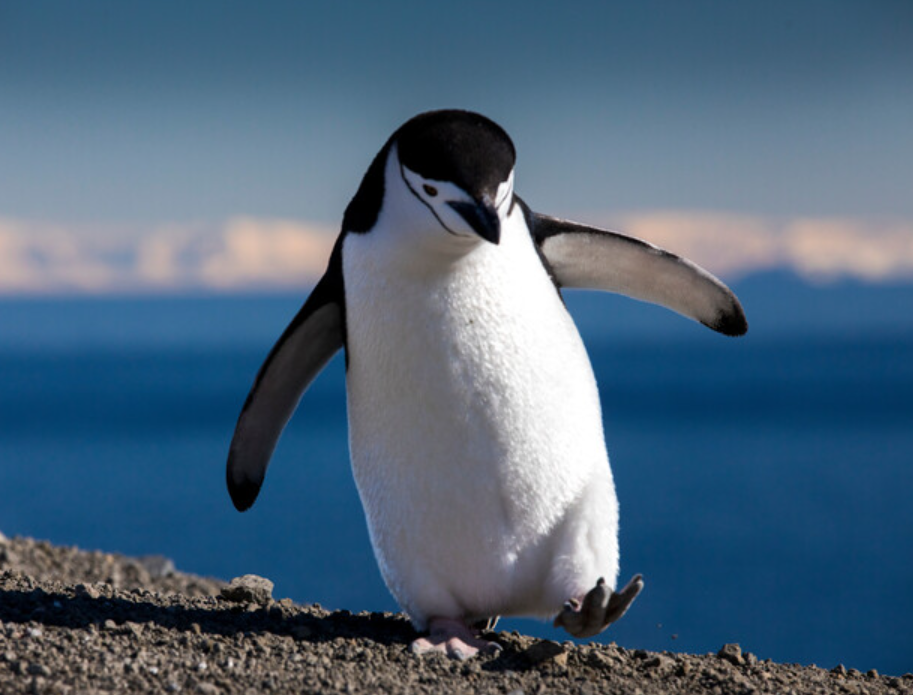
The life cycle of penguins is one of the most fascinating stories in the bird world. Penguins are flightless seabirds that spend much of their lives in the ocean, but they return to land or ice to breed, lay eggs, raise chicks, and molt. They are best known for their black-and-white body color, upright walking style, strong swimming ability, and excellent adaptation to cold marine environments. However, not all penguins live in Antarctica.
Many species live in South America, southern Africa, Australia, New Zealand, and the Galápagos region. Most penguins live in the Southern Hemisphere, and the Galápagos penguin is the only species that reaches slightly north of the Equator.
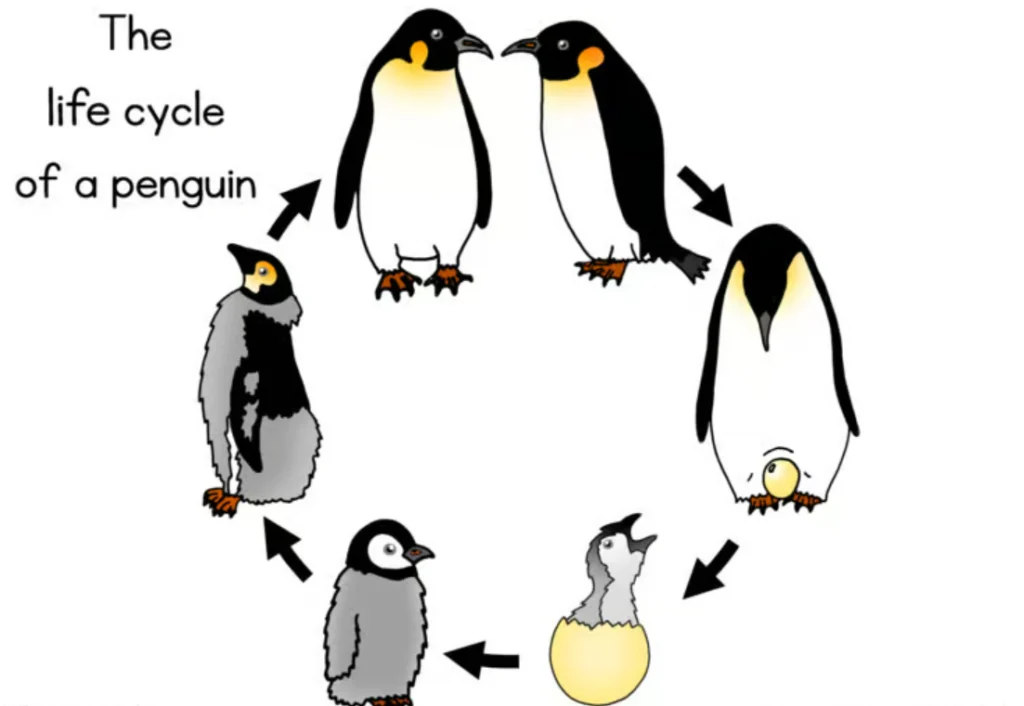
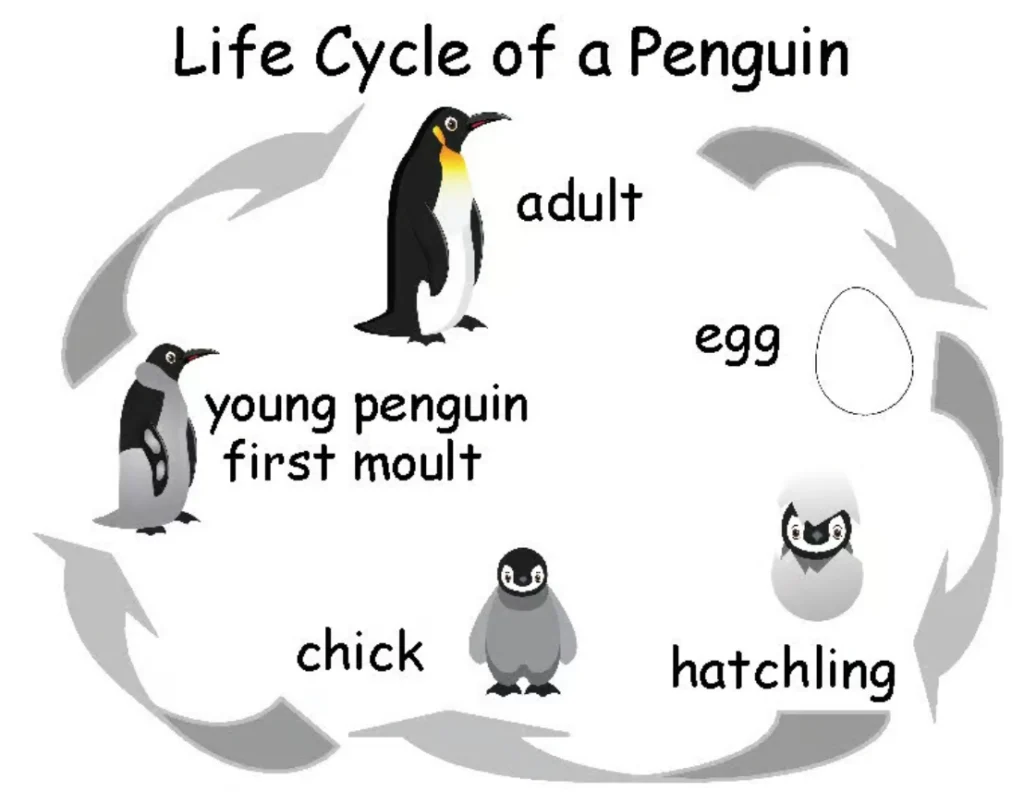
The keyword life cycle penguins usually refers to the full journey from egg to hatchling, chick, juvenile, and finally adult penguin. This cycle is shaped by food availability, sea temperature, predators, breeding colonies, and climate conditions. Today, penguins are also important indicators of ocean health because changes in sea ice, fish stocks, krill availability, and pollution directly affect their survival.
Q: What are the main stages in the life cycle of penguins?
A: The main stages are egg, hatchling, chick, juvenile, and adult.
Q: Where do penguins live?
A: Most penguins live in the Southern Hemisphere, including Antarctica, South America, South Africa, Australia, New Zealand, and nearby islands.
Q: What do penguins eat?
A: Penguins mainly eat krill, fish, and squid, depending on the species and habitat.
Quick Life Cycle Table
| Stage | What Happens | Simple Timeframe |
| Egg | Parent penguins lay and incubate the egg. | Usually, it takes weeks to about 2 months |
| Hatchling | The chick hatches from the egg and needs warmth. | First few days |
| Chick | Parents feed the chick with regurgitated food. | Several weeks to months |
| Crèche Stage | In some species, chicks gather in groups for warmth and safety. | After early growth |
| Juvenile | Young penguins grow waterproof feathers and enter the sea. | Before independence |
| Adult | Mature penguins hunt, molt, migrate, and breed. | Several years onward |
| Breeding Adult | Adults return to colonies to reproduce. | Usually seasonal |
The exact timing depends on the species. For example, Adélie penguin chicks may fledge much faster than king penguin chicks, which can take far longer before full independence.
The History of Their Scientific Naming
The scientific naming of penguins has an interesting history, as the word “penguin” was first applied to the great auk, a flightless bird of the Northern Hemisphere that later became extinct. Early European sailors saw similar-looking flightless seabirds in the Southern Hemisphere and began using the same common name for them, even though modern penguins are not closely related to the great auk.
Key points about their scientific naming:
- Penguins belong to the family Spheniscidae.
- Their order is commonly known as Sphenisciformes.
- The family Spheniscidae includes living and extinct penguins.
- The name Spheniscus comes from a Greek word meaning “wedge,” connected to the shape of their flipper-like wings.
- The number of recognized penguin species can vary slightly across taxonomic sources, but modern references commonly list 18-19 species.
This naming history shows how science corrected an early naming confusion and placed penguins in their own unique bird group.
Their Evolution And Their Origin
The origin of penguins goes back millions of years. Penguins evolved from flying bird ancestors, but over time, they lost the ability to fly and became powerful swimmers. Their wings changed into strong flippers, their bones became better suited for diving, and their body shape became smooth and torpedo-like for fast underwater movement.
Scientists believe penguins evolved in the Southern Hemisphere, especially around ancient southern oceans connected with Antarctica, New Zealand, and surrounding regions. Fossil evidence shows that ancient penguins appeared after the extinction of dinosaurs and became highly adapted to marine life. Some extinct penguins were much larger than living penguins today. Ancient giant penguins could reach human-like sizes, suggesting that penguin evolution was once far more diverse than it is today.
Modern penguins later spread into different environments. Some stayed in very cold regions such as Antarctica, while others adapted to temperate or warmer coastal areas. This is why today we find emperor penguins in Antarctica, African penguins in South Africa, little penguins in Australia and New Zealand, and Galápagos penguins near the Equator.
Their evolution is closely connected with ocean currents. Cold, nutrient-rich currents bring fish, krill, and squid near the surface, which helps penguins survive. So, the story of penguin evolution is not only about birds changing their bodies. It is also about oceans, climate, food chains, and survival pressure.
This long evolutionary journey made penguins one of the best examples of natural adaptation. They cannot fly in the sky, but underwater, they move with the speed and control of expert hunters.
Important Things That You Need To Know
When people search for life cycle penguins, they may also see related search terms like penguins, penguins schedule, pudgy penguins, penguins standings, and where do penguins live. These terms are useful for SEO, but not all of them mean the same thing.
First, penguins are real seabirds belonging to the family Spheniscidae. These birds live mainly in the Southern Hemisphere and depend on marine food such as krill, fish, and squid.
Second, where penguins live is directly related to this article. Penguins live in Antarctica, sub-Antarctic islands, South America, South Africa, Australia, New Zealand, and the Galápagos Islands. They do not naturally live in the Arctic.
Third, the term “the Penguins’ schedule” and “standings” often refer to the Pittsburgh Penguins hockey team, not the bird. These keywords can signal mixed search intent, so an article about the penguin life cycle should clearly explain the differences.
Fourth, Pudgy Penguins is associated with a digital brand and an NFT-style character collection, not real wildlife. It may appear in search results because it uses the word “penguins,” but it is separate from the field of animal biology.
For this reason, the best SEO approach is to focus mainly on real penguin life cycle, habitat, reproduction, diet, survival, and conservation while naturally clarifying unrelated search terms.
Their main food and its collection process
Penguins are marine hunters. Their main food usually includes krill, fish, and squid. The exact diet depends on the penguin species, location, season, and prey availability. Smaller Antarctic and sub-Antarctic penguins often eat more krill and squid, while species living farther north may depend more on fish.
Main food sources:
- Krill: Small shrimp-like animals, especially important for Antarctic penguins.
- Fish: A major food source for many species, including temperate-region penguins.
- Squid: Commonly eaten by larger penguins and some deep-diving species.
- Small marine animals: Some penguins also eat small crustaceans and other sea life.
Their food collection process is highly active. Penguins dive into the ocean and use their flippers like underwater wings. Their streamlined bodies help them move quickly through water. They catch prey with their beaks and swallow it whole while swimming.
Penguins also have strong eyesight underwater, which helps them detect moving prey. Their tongues and mouths have backward-facing structures that help hold slippery fish and squid.
Some penguins hunt alone, while others may feed near groups. Research using cameras on chinstrap penguins has shown that penguins can swim, dive, and feed together for long periods, suggesting that group behavior can sometimes help in feeding.
Food collection is one of the most dangerous parts of a penguin’s life. While hunting, penguins may face predators such as leopard seals, orcas, and sharks. They also depend on healthy oceans. If krill or fish numbers drop, the whole penguin life cycle becomes weaker.
Their life cycle and ability to survive in nature
Egg Stage
The life cycle starts when a female penguin lays an egg. Most penguins lay one or two eggs, depending on the species. The egg must be kept warm and protected from cold, wind, predators, and accidental damage.
Hatching and Chick Stage
After incubation, the chick hatches from the egg. At this stage, the chick is helpless and depends fully on its parents. It cannot hunt, cannot swim, and cannot properly control body temperature.
Parents feed the chick by bringing food from the sea and regurgitating it. This care continues until the chick grows stronger.
Juvenile Stage
As the chick grows, it develops waterproof feathers. This is a key survival step because without waterproof feathers, young penguins can freeze or drown in cold water. When the juvenile is ready, it enters the sea and begins learning to hunt.
Adult Survival
Adult penguins survive because of powerful adaptations. Their black-and-white body color gives them camouflage in water. Their thick feathers and fat layer protect them from the cold. Their flippers help them swim fast, and their social colonies help them breed and survive harsh weather.
In emperor penguins, survival is strongly linked to sea ice. Recent climate-related sea ice loss has caused major breeding failures in some colonies because chicks entered the water before developing waterproof feathers.
Their Reproductive Process and raising their children
Penguin reproduction is highly organized and strongly connected to colonies. Most penguins return to breeding areas during specific seasons. Some use rocky nests, some use burrows, and some, like the emperor penguin, breed on sea ice.
Key parts of the reproductive process:
- Courtship: Penguins use calls, body movements, and displays to attract mates.
- Pair bonding: Many penguins form seasonal pairs, though lifelong bonding depends on species and breeding success.
- Nest building: Some species collect stones, grass, or other materials. Others lay eggs in burrows or on their feet.
- Egg laying: The female lays 1 or 2 eggs, depending on the species.
- Incubation: One or both parents keep the egg warm.
- Feeding chicks: Parents take turns going to sea and returning with food.
- Guard phase: Parents closely protect young chicks during the early stage.
- Crèche stage: In some species, chicks gather in groups while parents hunt.
Emperor penguins have one of the most extreme parenting systems. The male holds the egg on his feet under a warm brood pouch while the female goes to sea to feed. After the chick hatches, both parents continue feeding and protecting it.
Penguin parenting is demanding. Some species have long chick-rearing periods. For example, the pre-fledging period can be much shorter in Adélie penguins but much longer in king penguins.
Raising chicks successfully depends on stable breeding grounds, enough food, and safe ocean conditions. If any of these fail, the next generation becomes at risk.
The importance of them in this Ecosystem
Penguins Support the Marine Food Web
Penguins are important middle-level predators. They eat krill, fish, and squid, and they are also prey for larger animals such as leopard seals, orcas, and sharks. This makes them a key part of the ocean food chain.
If penguin numbers fall sharply, it can signal wider problems in the marine Ecosystem.
Penguins Help Show Ocean Health
Because penguins depend on sea ice, fish stocks, krill, and clean water, scientists often study them as indicators of environmental change. A decline in penguin breeding success may suggest changes in sea temperature, prey availability, or ice conditions.
For example, emperor penguins are now under serious pressure from sea ice loss. The IUCN reported that climate-driven sea-ice changes are expected to cause major population decline by the 2080s.
Penguins Move Nutrients
Penguins feed in the ocean and return to land or ice colonies. Their waste adds nutrients to local ecosystems. This can support small organisms and affect the surrounding environment.
Penguins Support Education and Conservation Awareness
Penguins are also powerful symbols for wildlife protection. People connect emotionally with them, which helps raise awareness about climate change, overfishing, plastic pollution, and marine conservation.
Protecting penguins means protecting the wider ocean system they depend on.
What to do to protect them in nature and save the system for the future
Protecting penguins requires both local action and global environmental responsibility. Since penguins depend on oceans, climate, and breeding habitats, saving them also means saving marine ecosystems.
- Reduce climate change pressure: Lower carbon emissions to slow sea ice loss and ocean warming.
- Protect breeding colonies: Keep human disturbance, tourism pressure, and habitat damage away from sensitive nesting areas.
- Support sustainable fishing: Avoid overfishing of krill, fish, and squid because penguins need these food sources to survive.
- Reduce plastic pollution: Plastic waste can harm marine animals and damage the food web that penguins depend on.
- Control oil pollution: Oil spills can damage penguin feathers, making them difficult to stay warm and waterproof.
- Create marine protected areas: Safe feeding zones help penguins find food without heavy competition from industrial fishing.
- Support scientific monitoring: Satellite tracking, colony counts, and breeding studies help experts understand penguin population changes.
- Choose responsible tourism: Visitors should follow wildlife distance rules and avoid disturbing colonies.
- Protect krill populations: Krill are essential for many Antarctic animals, including penguins, seals, and whales.
- Educate people: Raise awareness that penguin survival is connected to climate, oceans, and human behavior.
Small actions matter, but large-scale policy and conservation programs are also needed.
Frequently Asked Questions (FAQs)
Q: What is the life cycle of penguins?
A: The life cycle of penguins includes egg, hatchling, chick, juvenile, and adult stages. Adults later breed and continue the cycle.
Q: How long does a penguin take to grow up?
A: It depends on the species. Some chicks become independent in a few months, while species like king penguins can take much longer.
Q: Where do penguins live?
A: Penguins mostly live in the Southern Hemisphere, including Antarctica, South America, South Africa, Australia, New Zealand, and the Galápagos Islands.
Q: Do penguins live at the North Pole?
A: No. Penguins do not naturally live at the North Pole or the Arctic region. They are mainly Southern Hemisphere birds.
Q: What do penguins eat?
A: Penguins eat krill, fish, squid, and other small marine animals.
Q: How do penguins feed their chicks?
A: Parent penguins catch food in the ocean, return to the colony, and feed chicks by regurgitating food.
Q: Why can’t penguins fly?
A: Penguins evolved for swimming instead of flying. Their wings became strong flippers for underwater movement.
Q: Are penguins endangered?
A: Some penguin species are threatened. The emperor penguin was listed as Endangered by the IUCN in 2026 because of climate-related sea ice loss.
Conclusion
The life cycle of penguins is a powerful example of survival, adaptation, and parental care in nature. From a fragile egg to a dependent chick, then to a young swimmer and finally a breeding adult, every stage depends on food, climate, safe colonies, and healthy oceans. Penguins may look simple and cute, but their biology is complex and highly specialized.
They are not just beautiful seabirds. They are also important signs of marine ecosystem health. When penguins struggle, it often means the ocean system around them is under pressure as well. Climate change, sea ice loss, overfishing, pollution, and human disturbance are now major concerns for many penguin populations.
Protecting penguins means protecting the balance of the ocean. By saving their food sources, breeding areas, and natural habitats, we also help protect the future of the wider marine Ecosystem.
Also Read: life cycle of ticks