The carpet beetle life cycle is a complete metamorphosis, meaning these insects pass through four distinct stages: egg, larva, pupa, and adult. Carpet beetles belong to the beetle family Dermestidae, a group also known as skin beetles, hide beetles, or larder beetles. They are small insects, but their larvae can cause serious damage to wool, silk, fur, feathers, leather, stored food, dried insects, and museum specimens.
A common mistake is thinking that adult carpet beetles eat carpets. In reality, adult carpet beetles usually feed on pollen and nectar, while the larvae are the damaging stage. Larvae prefer dark, quiet, hidden places such as closets, under furniture, baseboards, attics, stored clothing, bird nests, and areas where lint, pet hair, dead insects, or natural fibers collect.
The life cycle length depends on species, temperature, humidity, food quality, and indoor conditions. For example, some carpet beetles complete development in a few months, while others may remain in the larval stage for many months or even longer. This is why infestations can remain hidden for a long time before visible damage appears.
Quick Answers: Most Common Questions
Q: What are the four stages of the carpet beetle’s life cycle?
A: The four stages are egg, larva, pupa, and adult. The larval stage is usually the longest and most destructive stage.
Q: Which stage of carpet beetles damages clothes and carpets?
A: The larval stage causes the damage. Larvae feed on animal-based materials such as wool, fur, silk, feathers, leather, hair, and dried insects.
Q: How long does the carpet beetle’s life cycle take?
A: It varies by species and conditions. Some complete development in several months, while others may take one year or longer, especially if food or temperature conditions slow larval development.
Quick Life Cycle Table
| Stage | What Happens | Common Duration | Key Sign |
| Egg | Females lay tiny eggs near larval food sources | About 1–3 weeks | Hard to see; placed in hidden areas |
| Larva | Larvae feed, grow, and molt many times | Several months to more than a year | Bristly larvae, shed skins, fabric damage |
| Pupa | Larva transforms into an adult beetle | About 1–3 weeks | Hidden in cracks, fabric, or food source |
| Adult | Adult mates, flies, feed on pollen/nectar | Often 2–8 weeks | Small beetles near windows or flowers |
The exact timing changes by species. For example, UC IPM reports that varied carpet beetle larvae may last 220–630 days, while furniture carpet beetle larvae may last 70–94 days under the listed conditions.
The History of Their Scientific Naming, Evolution, and Origin
Scientific Naming
Carpet beetles are not one single species. There are several beetle species in the family Dermestidae. Common examples include the varied carpet beetle (Anthrenus verbasci), the furniture carpet beetle (Anthrenus flavipes), and the black carpet beetle (Attagenus unicolor).
Meaning Behind the Name
The name Dermestidae is connected with the idea of “skin-eating” beetles because many members of this family feed on dried animal materials such as skin, hair, feathers, horn, and fur. Britannica describes dermestid beetles as scavengers whose larvae feed on animal-based materials.
Evolution and Natural Origin
Before becoming household pests, carpet beetles were mainly natural recyclers. In the wild, larvae developed in bird nests, wasp nests, bee nests, spider webs, dead insects, and dried animal remains. Their ability to digest dry animal matter made them useful in nature, but the same ability makes them damaging indoors.
Global Spread
Some species, especially Anthrenus verbasci, are now widely distributed with human movement, stored goods, homes, museums, and trade. BugGuide describes the varied carpet beetle as cosmopolitan and notes its introduction into North America around the mid-1800s.
Their Reproductive Process, Giving Birth And Rising Their Children
Carpet Beetles Do Not Give Birth
Carpet beetles do not give birth to live young. They reproduce by laying eggs. After mating, the female chooses places where newly hatched larvae can immediately find food. This is why eggs are often placed near wool, fur, feathers, dried insects, lint, pet hair, stored foods, or abandoned nests.
Mating and Egg Laying
Adult carpet beetles mate after reaching maturity. Females can lay different numbers of eggs depending on the species. UC IPM reports typical egg numbers of about 40 eggs for varied carpet beetles, 60 eggs for furniture carpet beetles, and 90 eggs for black carpet beetles.
Where Females Place Eggs
Female carpet beetles are strategic. They lay eggs in dark, protected, food-rich areas. Indoors, this may include closets, under rugs, behind baseboards, inside upholstered furniture, or near stored animal-fiber products. Outdoors, they may use bird nests, wasp nests, bee nests, or spider webs.
Raising Their Children
Carpet beetles do not “raise” their young like birds or mammals. There is no parental care. The female’s main investment is choosing a good egg-laying site. Once eggs hatch, larvae survive by feeding, hiding, molting, and growing independently.
Why Their Reproduction Is Successful
Their reproductive strategy works because larvae can survive for a long time in hidden places. Even if adults are seen only briefly near windows, larvae may already be feeding quietly in carpets, clothing, stored goods, or museum specimens.
Stages of Carpet Beetle Life Cycle
1. Egg Stage
The egg stage begins when a female carpet beetle lays tiny eggs near a suitable food source. Eggs are usually white or pale and difficult to notice without close inspection. They may be hidden in fabric folds, cracks, lint, animal hair, or stored goods.
Eggs usually hatch in about one to three weeks, depending on the species and indoor temperature. UC IPM gives egg-hatching ranges of 10–20 days for varied carpet beetles, 9–16 days for furniture carpet beetles, and 6–16 days for black carpet beetles.
2. Larval Stage
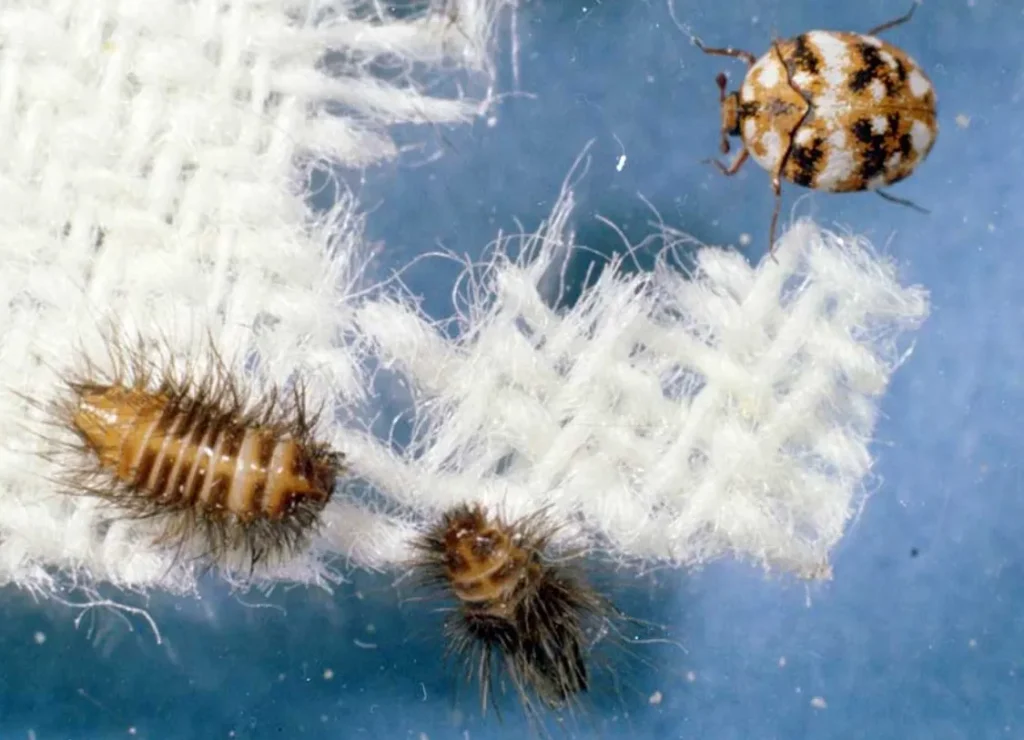
The larval stage is the most important stage to understand because it causes the real damage. Carpet beetle larvae are often hairy or bristly and may look like tiny brown, striped, or carrot-shaped worms. They avoid light and prefer quiet, undisturbed places.
Larvae feed on animal-based materials such as wool, fur, feathers, silk, leather, hair, dried insects, and sometimes stored foods. They molt several times as they grow, leaving behind dry, bristly cast skins. These shed skins are a common sign of infestation.
3. Pupal Stage
After feeding and growing, the larva enters the pupal stage. During this stage, the insect transforms into an adult beetle. Pupation may happen inside the food source, inside cracks, under carpets, behind baseboards, or even inside the last larval skin.
The pupal period is much shorter than the larval period. UC IPM reports pupation lasting around 10–13 days for varied carpet beetles, 14–17 days for furniture carpet beetles, and 8–14 days for black carpet beetles.
4. Adult Stage
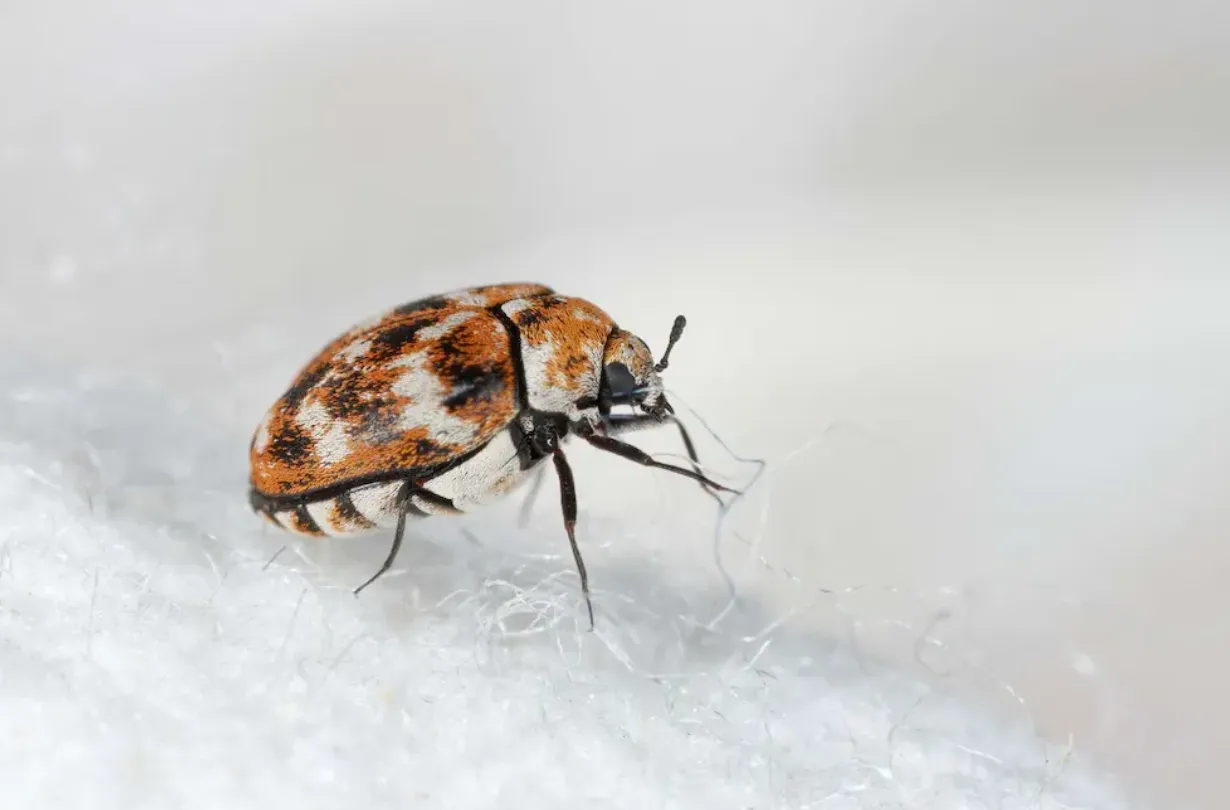
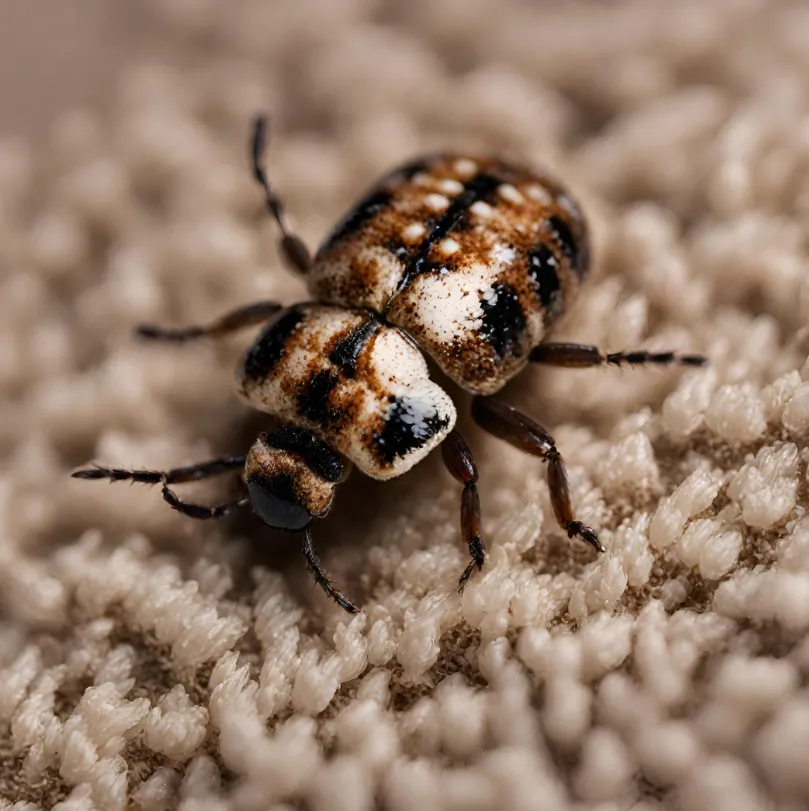
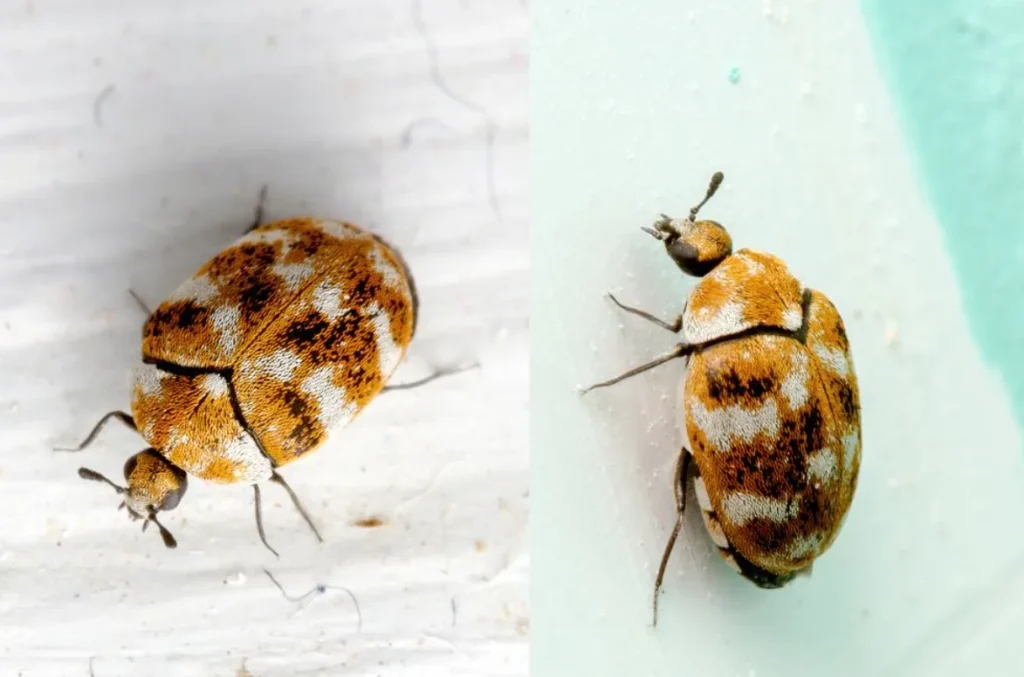
The adult stage is the reproductive stage. Adult carpet beetles are small, oval beetles. Some are black, while others have mottled patterns of white, brown, yellow, or gray scales. Adult Anthrenus species can look slightly like tiny ladybugs, but they behave differently.
Adults usually feed on pollen and nectar, not fabrics. They are often found near windows because they are attracted to light or are trying to move outdoors. Their main role is to mate and lay eggs so the life cycle can continue.
Important Things That You Need To Know
The phrase “carpet beetles” is often used casually, but it encompasses several related species. The most important thing to know is that adult carpet beetles and carpet beetle larvae behave very differently. Adults are usually short-lived, mobile, and often found near windows or flowers. Larvae are hidden, slow-moving, and responsible for most household damage.
Another important point is that a clean home can still get carpet beetles. The assumption that only dirty homes have them is wrong. Carpet beetles can enter through open windows, vents, flowers, second-hand furniture, stored fabrics, bird nests, or dead insects in hidden spaces. They can survive anywhere their larvae find enough protein-rich food.
The main warning signs include carpet beetle larvae, shed larval skins, irregular damage on wool or silk, small beetles near windows, and hidden feeding areas under furniture or along baseboards. A few adults do not necessarily indicate a major infestation, but repeated sightings should prompt an inspection.
For SEO and reader clarity, the most important related terms are carpet beetles, carpet beetle larvae, carpet beetle eggs, carpet beetle infestation, and carpet beetle damage. These terms help readers understand the full problem: identification, life cycle, damage, prevention, and ecological value.
The best approach is balanced: protect their role in nature, but control them indoors when they threaten clothes, carpets, stored food, or collections.
Their main diet, food sources, and collection process are explained
The diet of carpet beetles changes by life stage. Adult carpet beetles usually feed on pollen and nectar, while larvae feed on dry materials rich in animal protein. This is why adults may be seen on flowers outdoors, but larvae are found in closets, carpets, stored fabric, attics, and hidden dust.
Key food sources include:
- Wool carpets and wool clothing
- Fur, hides, and leather
- Feathers and down-filled items
- Silk and natural-fiber fabrics
- Pet hair and lint buildup
- Dead insects in windows, lights, and wall voids
- Taxidermy, dried specimens, and insect collections
- Dry stored foods such as grains, spices, nuts, and pet food, in some cases
Their “collection process” is not organized like ants or bees. Carpet beetle larvae do not collect food and store it. Instead, the female lays eggs near food, and the larvae crawl, feed, molt, and continue feeding in hidden places.
Larvae prefer food that is dry, undisturbed, and protected from light. A forgotten wool scarf, a dusty rug edge, a bird nest in an attic, or dead insects in a light fixture can support development. This is why inspection must focus on hidden areas, not just visible carpet surfaces.
How Long Does A Carpet Beetle Live
The lifespan of a carpet beetle depends strongly on the species and environment. It is better to think of lifespan in two ways: the full life cycle from egg to adult, and the short adult lifespan after emergence.
- The egg stage is short.
- Most carpet beetle eggs hatch in about one to three weeks. UC IPM gives species-specific hatching ranges from 6 to 20 days, depending on the type of carpet beetle.
- The larval stage is usually the longest.
- This stage may last several months or much longer. Virginia Tech notes that larval development can range from 3 to 36 months, depending on conditions. This wide range explains why infestations can feel difficult to eliminate.
- Food quality affects lifespan.
- Larvae develop faster when they have suitable food such as wool, fur, feathers, dried insects, or other protein-rich materials. Poor food, low temperature, or dry conditions may slow development.
- The pupal stage is short.
- Pupation typically lasts only a few days to a few weeks. UC IPM lists pupal periods from around 8 to 17 days for common carpet beetle species.
- Adults usually live only a few weeks.
- Adult varied carpet beetle females may live 2–6 weeks, while males may live 2–4 weeks. Furniture and black carpet beetle adults may live around 4–8 weeks.
- A full life cycle can be surprisingly long.
- Some carpet beetles may complete development in months, but others may take close to a year. Utah State University reports that the varied carpet beetle life cycle may take about 1 to 3 years under certain conditions.
- Indoor environments can extend survival.
- Homes provide stable temperatures, hidden spaces, and a constant food source, such as lint, pet hair, natural fabrics, and dead insects.
- Seeing adults does not reveal the full age of the infestation.
- Adults are only the final stage. By the time adults appear near windows, larvae may have been feeding for months.
Carpet Beetles Lifespan in the Wild vs. in Captivity
Lifespan in the Wild
In the wild, carpet beetles live in places where dry organic material naturally collects. This includes bird nests, wasp nests, bee nests, spider webs, animal remains, and dry insect debris. Their survival depends on seasonal temperature, predators, humidity, and available food. Outdoor adults feed on pollen and nectar, while larvae develop where animal-based debris is available.
Lifespan Indoors or in Human-Controlled Spaces
Indoors, carpet beetles may survive longer because homes, warehouses, and museums can provide steady shelter and food. Larvae may feed on wool, fur, feathers, stored food, dry pet food, museum specimens, or hidden dead insects. These protected environments can allow infestations to continue quietly.
Captivity and Laboratory-Like Conditions
In controlled settings, development may become more predictable because temperature, food, and humidity can be managed. However, poor food or cooler conditions may still slow larval growth. This is why scientific reports often report different life cycle lengths across species and conditions.
Main Difference
The biggest difference is stability. The wild is riskier, but homes offer steady shelter. That is why carpet beetle infestations can persist indoors unless the food source is found and removed.
Importance of Carpet Beetles in this Ecosystem
Natural Recyclers
Although carpet beetles are pests indoors, they are useful in nature. Their larvae help break down dead insects, feathers, hair, skin, nests, and dried animal remains. This recycling process returns nutrients to the environment and reduces leftover organic waste.
Part of the Food Web
Carpet beetles are also part of the food chain. Birds, spiders, predatory insects, and other small animals may feed on beetles or larvae. Their presence supports Biodiversity, especially in hidden microhabitats such as nests, tree hollows, and dry organic debris.
Useful in Museums and Taxidermy
Museum workers and taxidermists intentionally use some dermestid beetles to clean soft tissue from skeletons. This shows that the same feeding habit that causes damage indoors can be useful when controlled carefully.
A Warning Signal Indoors
Indoors, carpet beetles may indicate hidden food sources such as dead insects, abandoned nests, pet hair buildup, or stored natural fibers. Their presence can help people discover overlooked sanitation or storage problems.
Balanced Understanding
Carpet beetles are not “bad” insects by nature. They become a problem when their natural recycling behavior moves into human belongings.
What to do to protect them in nature and save the system for the future
1. Protect Natural Nesting and Recycling Areas
- Leave harmless outdoor organic zones undisturbed when they are not near homes.
- Natural debris, old nests, and dry remains can support decomposers.
- Avoid unnecessary destruction of every small insect habitat.
2. Use Indoor Control, Not Outdoor Elimination
- Control carpet beetles inside homes, closets, museums, and storage areas.
- Do not treat outdoor spaces with broad chemicals unless there is a clear need.
- Remember that many dermestid beetles are natural recyclers outdoors.
3. Reduce Chemical Overuse
- Avoid heavy pesticide use in gardens and around flowers.
- Adult carpet beetles visit flowers for pollen and nectar.
- Overusing insecticides may harm pollinators and other beneficial insects.
4. Manage Waste and Stored Materials Responsibly
- Keep homes clean, but allow nature to recycle safely outdoors.
- Store wool, fur, feathers, and taxidermy properly indoors.
- Remove abandoned nests from attics only when they pose a threat to indoor infestation.
5. Support Biodiversity
- Plant native flowers and maintain healthy garden spaces.
- A balanced ecosystem supports predators that naturally limit carpet beetle populations.
- Protecting Biodiversity helps prevent one insect group from becoming too dominant.
Fun & Interesting Facts About Carpet Beetles
- Carpet beetles are not born as carpet-eaters.
- They evolved as natural recyclers of dried animal material, not as household pests.
- The larvae cause the damage, not the adults.
- Adult carpet beetles usually feed on pollen and nectar, while larvae feed on wool, fur, feathers, and similar materials.
- They can live hidden for months.
- The larval stage may last much longer than people expect, making infestations difficult to detect early.
- Shed skins are major clues.
- Carpet beetle larvae molt as they grow and leave behind dry, bristly cast skins.
- They are museum pests.
- Some species can damage insect collections, stuffed animals, preserved birds, and taxidermy specimens.
- They can also be useful.
- Certain dermestid beetles are used to clean skeletons for museums and taxidermy work.
- They do not eat clean synthetic fibers.
- Larvae usually prefer animal-based materials, though soiled synthetic or plant fabrics may attract them if food stains or animal residues are present.
- A few adults do not always mean disaster.
- Adult beetles may fly indoors from flowers, but larvae or repeated adult sightings should be investigated.
Frequently Asked Questions (FAQs)
Q: What is the carpet beetle’s life cycle?
A: The carpet beetle’s life cycle has four stages: egg, larva, pupa, and adult. The larval stage is the longest and most damaging stage.
Q: How long do carpet beetle larvae live?
A: Carpet beetle larvae may live for several months or longer. Some sources report larval development from 3 to 36 months, depending on species, food, and environmental conditions.
Q: Do carpet beetles bite humans?
A: Carpet beetles do not bite like bed bugs or fleas. However, their bristly larval hairs may irritate sensitive skin in some people. The main problem is usually fabric and stored-product damage, not biting.
Q: Where do carpet beetles lay eggs?
A: Females lay eggs near food sources for larvae. Common places include wool clothing, carpets, rugs, fur, feathers, pet hair, lint, dead insects, stored foods, bird nests, and dark cracks.
Q: Are carpet beetles important in nature?
A: Yes. In nature, carpet beetle larvae help recycle dried animal material such as feathers, hair, dead insects, skin, and nest debris. They become pests only when they feed on human belongings indoors.
Conclusion
The carpet beetle’s life cycle is simple in structure but complex in behavior. These insects pass through egg, larva, pupa, and adult stages, but the larval stage is the most important because it causes damage and can last for a long time. Adult carpet beetles are often harmless flower visitors, while larvae are hidden feeders that target wool, fur, feathers, silk, leather, dried insects, and stored materials.
Understanding their life cycle helps with both prevention and control. Instead of only killing visible adult beetles, the real solution is to find larval food sources, remove hidden debris, clean storage areas, protect natural fibers, and monitor dark, undisturbed spaces.
At the same time, carpet beetles should not be viewed only as pests. In nature, they are valuable recyclers. A balanced approach protects their ecological role outdoors while preventing carpet beetle damage indoors.
Also Read: canine parvovirus life cycle