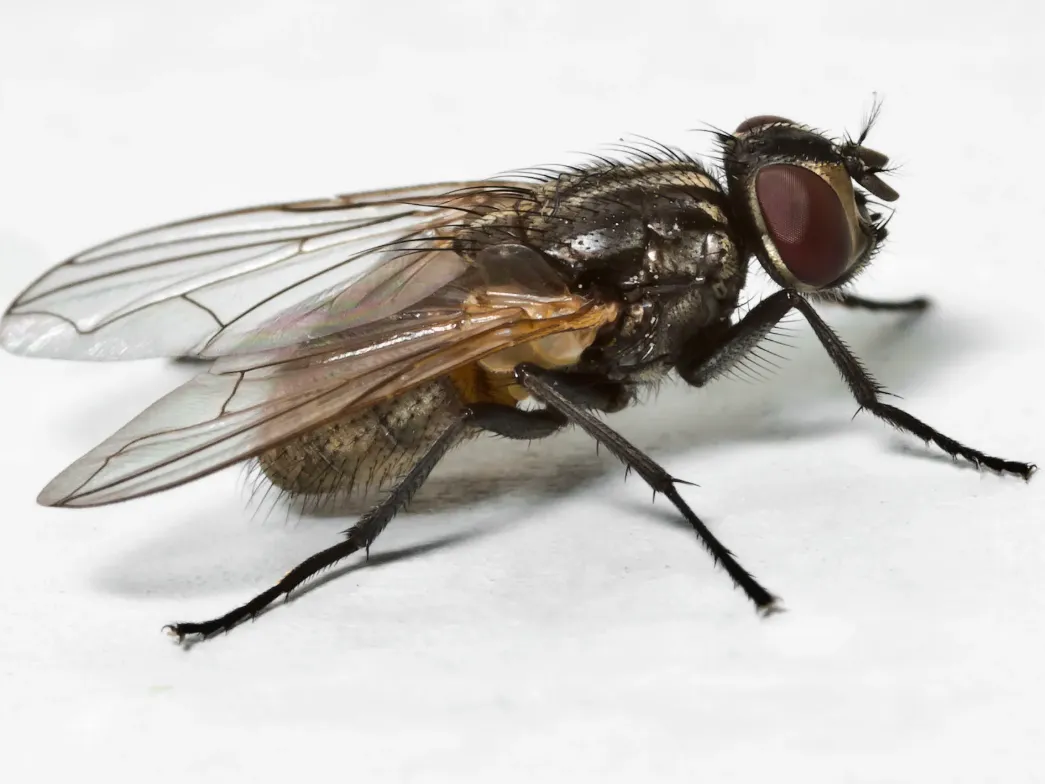
House flies (Musca domestica) are among the most ubiquitous and persistent pests in human environments. Although they may seem insignificant at first glance, house flies are vectors for numerous diseases and contribute to the degradation of food and hygiene in homes and businesses. Understanding the life cycle and behavior of house flies can help manage their populations and mitigate their impact. In this article, we will explore the fascinating life cycle of house flies, their reproductive process, their evolutionary background, and more.
Quick Answers to the Most Common Questions About House Flies:
- How long does a house fly live?
- House flies typically live for about 2 to 3 weeks, but this duration can vary depending on environmental conditions such as temperature and food availability.
- How do house flies reproduce?
- Female house flies lay eggs on decaying organic matter, such as food scraps and manure. These eggs hatch into larvae, which later metamorphose into adult flies after a brief pupation period.
- How can I control or eliminate house flies?
- Effective methods of house fly control include using traps, applying insecticides in areas where flies congregate, keeping food sealed, and maintaining clean environments, especially around waste and garbage.
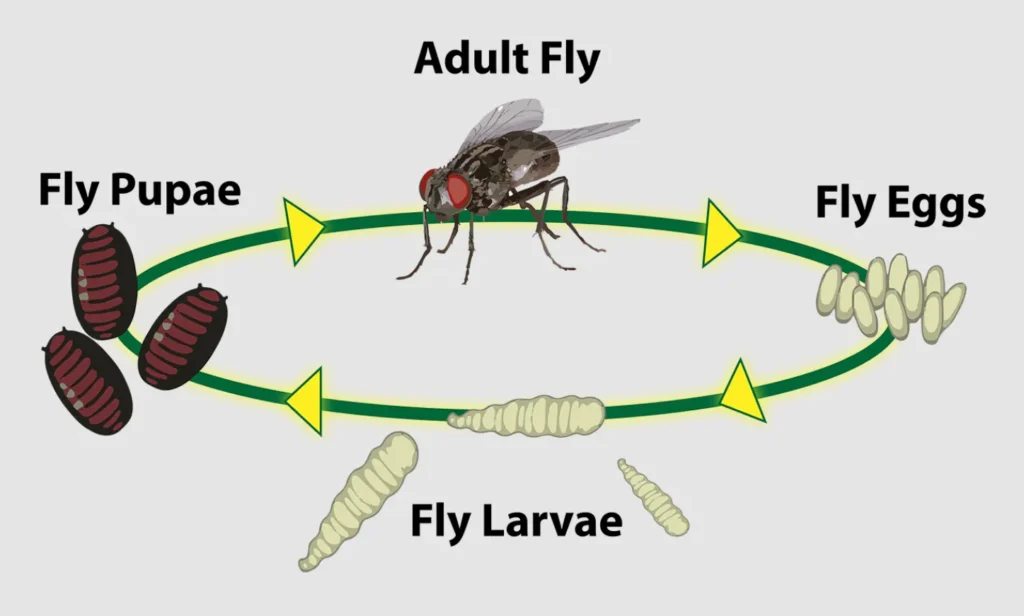
Quick Life Cycle Table
| Life Cycle Stage | Duration | Description |
| Egg | 1-2 days | Female house flies lay eggs, often in decaying organic matter, such as food scraps or manure. |
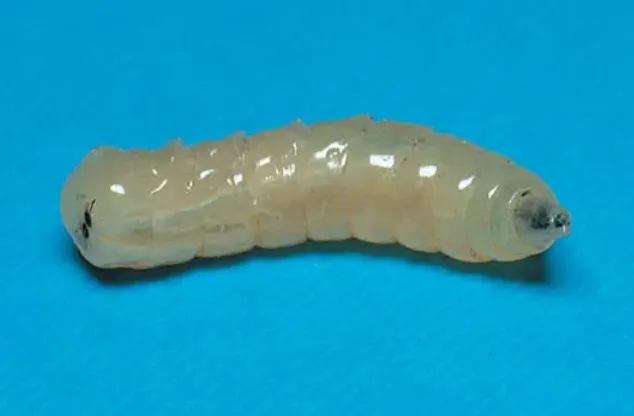
| Larvae (Maggots) | 3-7 days | The eggs hatch into larvae that consume decaying matter to grow quickly. |
| Pupa | 1-3 weeks | The larvae undergo pupation, transitioning into the adult fly stage. |
| Adult | 2-3 weeks | The adult fly emerges, mates, and begins the cycle again by laying eggs. |
The History of Their Scientific Naming
The house fly was first classified by Carl Linnaeus in 1758. He named it Musca domestica, where the genus Musca is derived from the Latin word for “fly,” and domestica refers to its tendency to inhabit human environments, specifically homes and buildings. This scientific name reflects the fly’s strong association with human habitats, a relationship that has only grown stronger over the centuries.
The scientific study of house flies is essential not only for understanding their biology but also for controlling their populations, as they can carry diseases and impact food safety. Over time, their naming has served as a reminder of their close ties to humans.
Their Evolution and Their Origin
The evolution of the house fly is tied to the broader development of insects that interact closely with humans. While the exact origins of Musca domestica are still debated, it is generally believed that house flies evolved from more primitive fly species that emerged around 100 million years ago during the Mesozoic era. Early ancestors of house flies likely lived in environments with abundant decaying organic matter, a resource they continue to rely on today.
As humans began to settle in communities, house flies adapted to live in areas with food waste, manure, and other organic materials. They are now among the most common pests worldwide, in both urban and rural settings. Their ability to thrive in a variety of environments, especially in warm climates, has made them resilient to many environmental challenges.
Their Main Food and Its Collection Process
House flies are attracted to decaying organic matter, which serves as their primary food source. This includes food scraps, animal waste, decaying plants, and garbage. Their feeding process is unique compared to other insects:
Main Food Sources:
- Food scraps: Leftover food, particularly sugary or decaying foods.
- Animal waste: Manure and animal carcasses are ideal environments for hatching eggs.
- Rotting organic matter: This includes plants and decaying organic materials found in garbage and compost.
Feeding Process:
House flies use their sponging mouthparts to feed on liquidized substances. When they land on their food source, they secrete digestive enzymes that liquefy the material. They then lap up the liquefied food, enabling them to feed on a broad range of decaying substances. This feeding mechanism is why flies are associated with contamination and the spread of disease.
Their Life Cycle and Ability to Survive in Nature
Life Cycle and Stages:
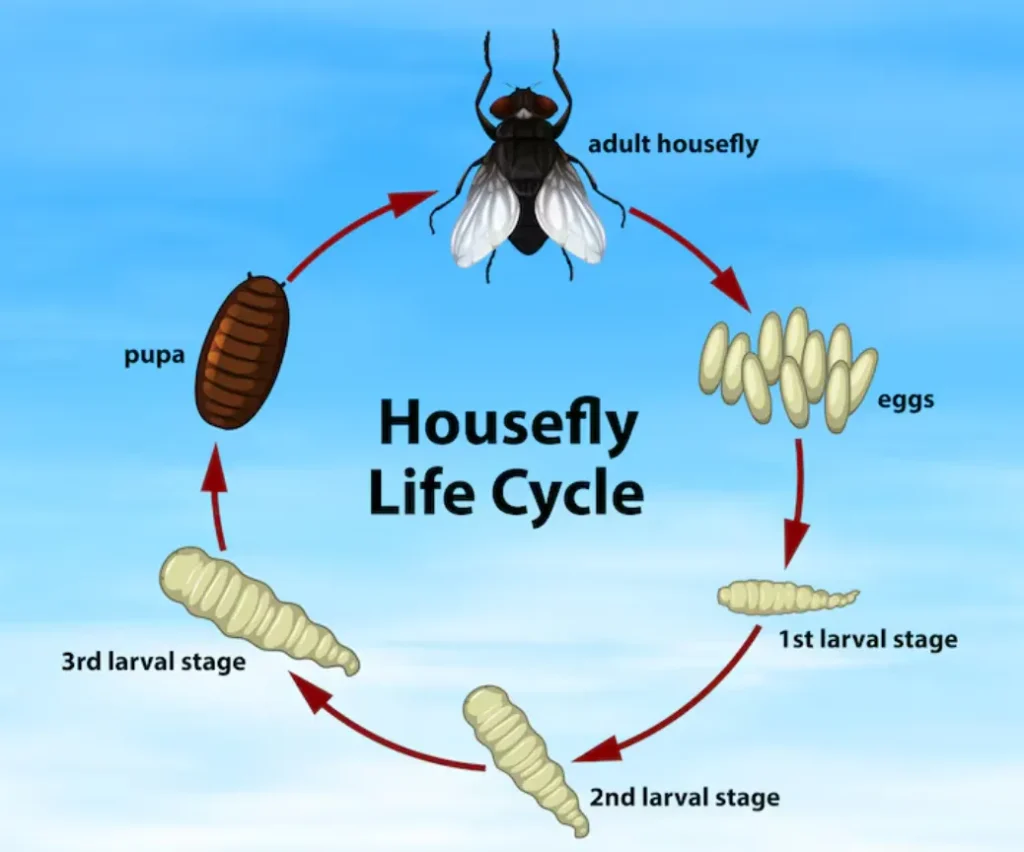
House flies undergo complete metamorphosis, passing through four distinct stages: egg, larva (maggot), pupa, and adult. This complete life cycle allows for rapid reproduction and spread, making house flies particularly hard to control.
Ability to Survive in Nature:
- House flies are highly adaptable to various environments, particularly warm, moist areas with abundant organic waste.
- They can fly long distances and quickly find food sources, contributing to their spread in urban areas.
- The fast reproductive cycle of house flies enables them to survive in almost any environment, making them among the most successful insects in terms of population growth.
Their resilience is largely due to their ability to mature and reproduce rapidly, allowing house flies to thrive even in less-than-ideal conditions. This adaptation has made house flies a permanent fixture in human habitats worldwide.
Their Reproductive Process and Raising Their Children
House flies reproduce prolifically, with females capable of laying up to 500 eggs in their lifetime. These eggs are laid in moist, decaying organic material where larvae (maggots) will have an ample food source. Once hatched, the larvae go through several growth stages before pupating and emerging as adults.
Reproductive Process:
- Egg laying: A female fly lays her eggs in decaying organic matter, such as food waste or animal manure.
- Larval stage: Eggs hatch into larvae that feed on surrounding organic material and grow rapidly.
- Pupation: After feeding, the larvae enter the pupal stage, where they undergo metamorphosis into adult flies.
- Mating and reproduction: Adult flies mate shortly after emerging and start the cycle over by laying eggs.
This efficient reproductive cycle enables rapid population growth of flies, especially in environments with abundant resources.
Importance of Them in This Ecosystem
While house flies are often seen as pests, they play a critical role in the ecosystem. House flies contribute to the breakdown of organic matter and the recycling of nutrients, which helps maintain the balance of ecosystems.
Ecological Role:
- Decomposers: House flies feed on decaying organic material, helping to break down waste and return nutrients to the soil.
- Food source: They are an important food source for various predators, including birds, amphibians, and other insects.
- Pollination: While not primary pollinators, house flies do contribute to plant pollination as they move between food sources.
Their role in nutrient cycling and as a food source for other species highlights their importance, despite being regarded as pests in human environments.
What to Do to Protect Them in Nature and Save the System for the Future
Although house flies can be a nuisance, they are vital to ecological balance. Here are some measures to protect them while managing their populations:
- Minimize pesticide use: Over-reliance on pesticides can harm not only flies but also other beneficial organisms in the ecosystem.
- Proper waste management: Proper disposal prevents overpopulation of house flies in urban areas.
- Encourage biodiversity: Protecting other species and habitats ensures that flies continue to play their ecological role.
By fostering environments where flies and other organisms can thrive, we can maintain ecological balance while minimizing their impact on human activities.
Important Things That You Need to Know
House Fly Traps and How They Work
House fly traps are an effective tool for controlling fly populations without using chemicals. These traps typically use food-based attractants or light to lure flies in. Once inside, the flies are trapped and cannot escape. This provides a chemical-free way to manage infestations in homes, restaurants, and other establishments. Some traps are reusable, while others are disposable.
House Fly Bites and Their Impact
Though house flies do not bite like mosquitoes, they can still pose a risk to human health. House flies are known to carry pathogens such as Salmonella, E. coli, and Shigella, which they spread through their saliva and feces and by landing on food. This makes them a significant threat to food hygiene and health, especially in areas where food is prepared or consumed.
Horse Fly vs. House Fly
Despite their similar names, horse flies and house flies are very different. Horse flies are larger, more aggressive, and capable of biting mammals to feed on blood. In contrast, house flies feed primarily on decaying organic matter. While horse flies are more harmful to humans and animals due to their biting behavior, house flies are notorious for carrying disease-causing bacteria.
Frequently Asked Questions (FAQs)
- How long do house flies live?
- House flies typically live for 2-3 weeks, though environmental factors can influence their lifespan.
- What do house flies eat?
- House flies feed on decaying organic matter, including food scraps, animal waste, and garbage.
- Are house flies harmful to humans?
- Yes, house flies are known to carry and spread harmful bacteria that can cause foodborne illnesses.
- How do you prevent house flies in your home?
- Keep your environment clean, seal food, remove garbage regularly, and use fly traps to reduce fly populations.
- What is the lifespan of a housefly?
- A house fly’s lifespan is usually 2 to 3 weeks, but it can vary based on environmental conditions.
- Where do house flies lay eggs?
- House flies lay eggs in decaying organic material, such as manure, garbage, or food scraps.
- Can house flies spread diseases?
- Yes, house flies can spread bacteria and viruses by landing on surfaces, contaminating food and other objects.
- How can you trap house flies effectively?
- Use traps with food or light attractants. Commercial traps or DIY traps using sugar water can be effective.
Conclusion
House flies may be a common pest, but they play a critical role in the ecosystem. Understanding their life cycles, feeding habits, and reproductive processes helps control their populations while recognizing their importance in nature. By adopting eco-friendly practices and ensuring proper waste management, we can keep house fly populations in check while preserving the balance of the environment.
Also Read: bunny life cycle