The pantry moth life cycle is the complete development process of the common food-storage moth, usually called the pantry moth, Indianmeal moth, flour moth, or grain moth. The most common species linked with pantry infestations is Plodia interpunctella, a small moth from the family Pyralidae. It is widely known because its larvae infest stored dry foods such as grains, cereals, flour, nuts, dried fruit, seeds, spices, chocolate, powdered milk, birdseed, and dry pet food.
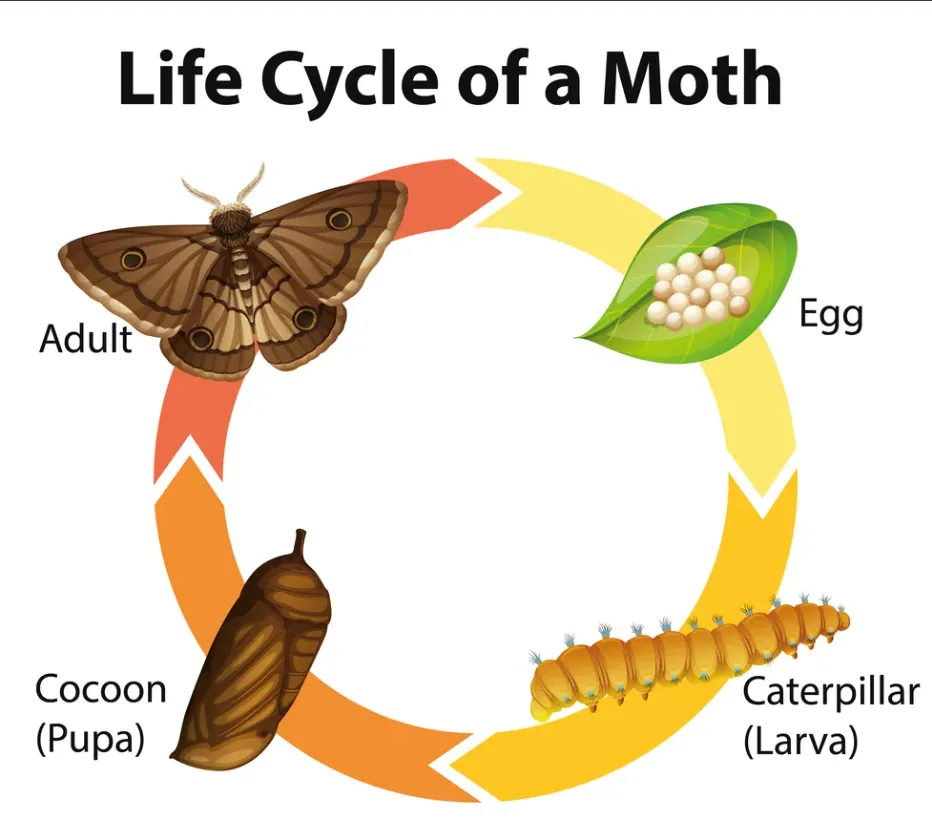
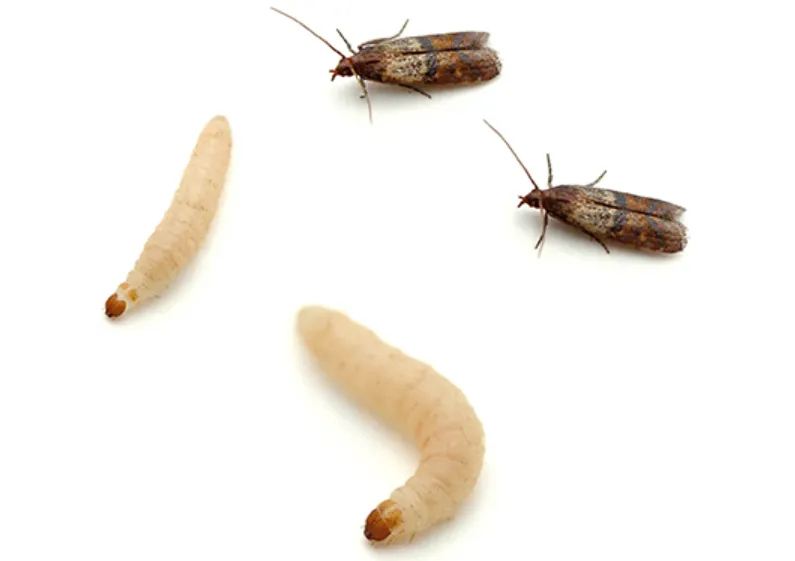
A pantry moth has four life stages: egg, larva, pupa, and adult moth. The larval stage is the most damaging because pantry moth larvae feed inside or near food products and produce silk webbing, frass, cast skins, and contamination. Adult moths are mostly a sign that the infestation has already developed; they usually do not feed and live mainly to mate and lay eggs.
Under warm, favourable indoor conditions, the life cycle may finish in about 6–8 weeks. Still, research and extension sources indicate a wider range of 27-305 days, depending on temperature, humidity, food quality, and storage conditions.
Q: What is a pantry moth?
A: A pantry moth is a stored-food moth, most often Plodia interpunctella, whose larvae infest dry foods in kitchens, warehouses, grocery stores, and food-storage areas.
Q: Which stage causes the most damage?
A: The pantry moth larvae cause real damage because they feed on food and create silk webbing and waste inside stored products.
Q: How fast can the pantry moth life cycle finish?
A: In warm conditions, it may finish in about 6–8 weeks, but in cooler or less suitable conditions, development can take several months.
Quick Life Cycle Table
| Stage | Mobile-Friendly Quick Details |
| Egg | Tiny, pale eggs are laid directly on or near dry food. A female may lay 200–400 eggs, depending on conditions. Eggs can hatch in a few days to about two weeks. |
| Larva | This is the feeding stage. Pantry moth larvae eat grains, nuts, cereals, seeds, dried fruits, pet food, and similar stored products. They make silk webbing and are responsible for most contamination. |
| Pupa | Mature larvae leave the food source and form cocoons in cracks, corners, lids, ceilings, shelves, or packaging folds. The pupal stage may last about 1–3 weeks, depending on temperature. |
| Adult | Adult moths are small, greyish-brown to coppery moths. They usually live for 1 to several weeks, mate, and then start the cycle again. |
Important Things That You Need To Know
The keyword “pantry moth life cycle” is closely related to several common search terms: pantry moth, pantry moth larvae, what is a pantry moth, pantry moth traps, pantry moth eggs, pantry moth trap, and pantry moth eggs pictures.
The most important point is that the visible flying moth is not the main problem. The adult moth tells you that the hidden larval stage may already be active in dry food. Pantry moth larvae are the stage that eats and contaminates food. They often stay near the food surface, spin silk, and bind food particles together. This is why infested flour, cereal, nuts, or pet food may look clumpy, webbed, dusty, or dirty.
People often search for pictures of pantry moth eggs, but the eggs are extremely small and hard to identify with the naked eye. They are usually laid on food surfaces, in package seams, or near food sources. Because eggs are easy to miss, cleaning only the visible moths is not enough.
Pantry moth traps are useful for monitoring adult male moths, especially pheromone sticky traps. However, a pantry moth trap alone usually cannot remove an infestation because it does not remove eggs, larvae, pupae, or hidden food sources. Effective control depends on finding infested food, discarding or treating it, vacuuming cracks, and storing dry goods in tightly sealed containers.
The History of Their Scientific Naming, Evolution, and Origin
Scientific naming
The pantry moth most commonly discussed in homes is Plodia interpunctella. According to GBIF taxonomy, the species is classified under Animalia, Arthropoda, Insecta, Lepidoptera, Pyralidae, Plodia, and Plodia interpunctella. The scientific authority is listed as Hübner, 1813, and older synonyms include Tinea interpunctella.
Common name history
The common name Indianmeal moth comes from its association with “Indian meal,” an old term used for maize or cornmeal. This does not mean the moth is native only to India. In practical household language, it became known as the pantry moth because it is frequently found in stored kitchen foods.
Evolution and origin
Evolutionarily, pantry moths belong to a group of moths that developed strong survival strategies for seeds, grains, and dried plant materials. Their larvae are adapted to feeding in concentrated food sources, spinning protective silk, and pupating away from feeding sites. Today, Plodia interpunctella is considered a worldwide stored-product pest and is strongly associated with human food storage and global movement of dry commodities.
Their Reproductive Process, Giving Birth And Rising Their Children
They do not give birth like mammals.
A pantry moth does not give live birth. Female moths reproduce by laying eggs. These eggs are usually placed directly on or near suitable dry food so that the newly hatched larvae can begin feeding quickly.
Mating after adult emergence
Adults usually mate soon after leaving the pupal stage. Extension sources report that mating and egg laying may begin about three days after adult emergence. This fast reproductive timing helps infestations expand quickly when dry food is available.
Egg-laying process
A female pantry moth may lay around 200–400 eggs over several days. Eggs can be laid singly or in clusters, often in food packages, shelf cracks, folds, seams, or directly on grains, flour, nuts, and pet food.
No parental care
Pantry moths do not raise their young. After laying eggs, the adult female does not feed, protect, or guide the larvae. The survival of the young depends on whether the eggs were placed near a suitable food source.
Why is reproduction hard to stop
The reproductive process is difficult to control because eggs are tiny, larvae can hide inside food, and mature larvae may crawl away to pupate in cracks or hidden corners. This is why full cleaning, food inspection, and airtight storage are more effective than killing only adult moths.
Stages of Pantry Moth Life Cycle
1. Egg stage
The egg stage begins when the female lays small, pale eggs on or near dry food. These eggs are difficult to see without close inspection. Depending on the temperature, eggs may hatch in a few days to about two weeks. For example, IFAS notes that eggs hatch faster at warmer temperatures, around 3–4 days at 30°C, compared with 7–8 days at 20°C.
2. Larval stage
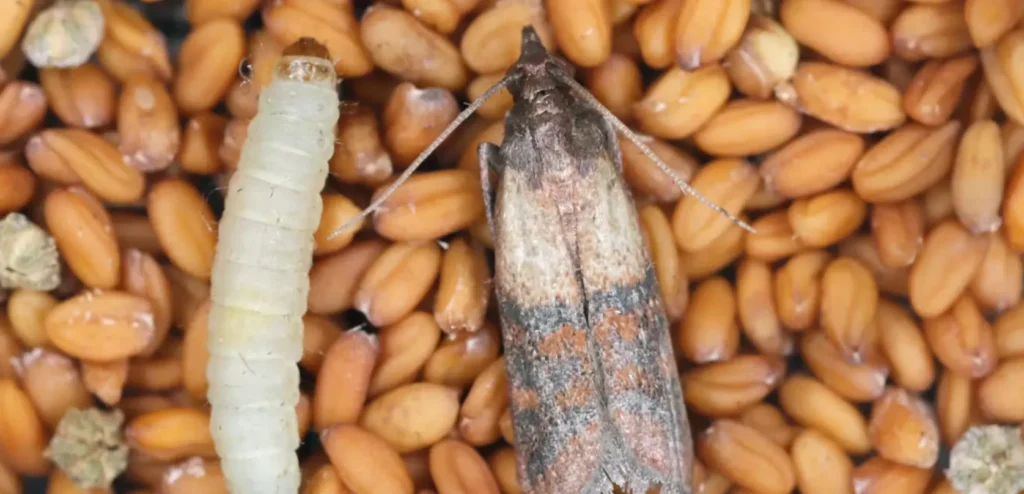
The larval stage is the most important in the pantry moth life cycle because this is when feeding and damage happen. Pantry moth larvae are small caterpillars, usually cream-coloured, sometimes with pinkish, yellowish, or greenish tones, and they have darker head capsules. They feed on dry stored foods and spin silk that can mat food particles together.
3. Pupal stage
When larvae mature, they often leave the food source and search for a protected place to pupate. They may pupate in shelf corners, wall gaps, ceiling edges, package folds, jar lids, or cracks. This behaviour makes infestations difficult to remove because the original food source may be cleaned, but pupae may remain nearby.
4. Adult moth stage
The adult pantry moth is the flying stage. Adults are usually small, with wings that may show grey, brown, bronze, or coppery tones. They are commonly noticed flying around kitchens, lights, walls, or ceilings. Adults mainly exist to mate and reproduce; they are not the main feeding stage.
Their Main Diet, Food Sources, And Collection Process Explained
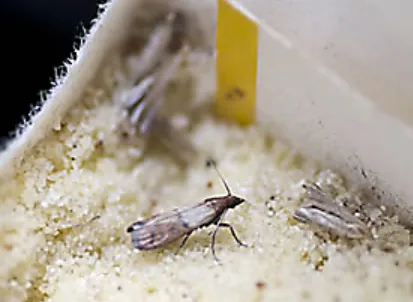
Pantry moths are not collectors like bees or ants. They do not gather food and store it for a colony. Instead, the female lays eggs near food, and the larvae feed directly where they hatch.
Their main diet includes dry, plant-based, and stored products. Common food sources include:
- Grains and grain products such as rice, flour, cornmeal, oatmeal, breakfast cereal, pasta, and biscuit crumbs.
- Nuts and seeds such as almonds, walnuts, peanuts, sunflower seeds, bird seed, and seed-based craft items.
- Dried fruits and vegetables such as raisins, dates, figs, dried berries, and dried soup mixes.
- Protein-rich dry goods such as powdered milk, dry pet food, fish food, and some animal-feed products.
- Flavouring items such as spices, dried herbs, chilli powder, cocoa, and chocolate.
The feeding process begins when newly hatched larvae move into a suitable food source. They may feed on the surface of large containers or inside loose packaging. As they feed, they spin silk, which can bind food particles together. This silk webbing is one of the clearest signs of infestation.
Larvae may also chew through thin cardboard or plastic packaging, especially when food is loosely sealed. That is why airtight glass, metal, or thick plastic containers are recommended for prevention.
How Long Does A Pantry Moth Live
The answer depends on whether you mean the full pantry moth life cycle or only the adult flying moth. The full cycle can be much longer than the adult stage.
- Full life cycle: Under favourable warm conditions, the pantry moth life cycle may be completed in about 6–8 weeks. However, under variable conditions, the full cycle can range from about 27 to 305 days.
- Egg stage: Eggs may hatch within a few days in warm temperatures, but may take longer in cooler environments. Warmer storage areas speed up development.
- Larval stage: The larval period may last several weeks or longer. This is the feeding stage, and its length depends on food quality, temperature, and moisture conditions.
- Pupal stage: The pupal stage may last around one to three weeks, depending on temperature. At warmer temperatures, pupal development is usually faster.
- Adult stage: Adult pantry moths usually live for a short time. Colorado State University notes that adults survive about a week without feeding. At the same time, other sources on extension and pest biology describe adult survival as lasting from several days to a few weeks under different conditions.
- Why infestations seem endless: Even if adult moths die quickly, eggs, larvae, and pupae may still be hidden. This is why seeing new moths after cleaning does not always mean the treatment failed; it may mean hidden pupae have emerged.
- Temperature effect: Warm rooms, stored grains, and stable indoor environments speed up development. Cooler conditions slow the cycle and may stretch development over months.
- Food effect: High-quality food such as nuts, grains, and pet food can support faster larval growth. Poor food or disturbed storage may slow survival.
Pantry Moth Lifespan in the Wild vs. in Captivity
Lifespan in the wild or outdoor environment
In outdoor or semi-natural conditions, pantry moth survival depends on temperature, humidity, predators, and food availability. They may use dried seeds, grains, nuts, or stored plant materials when available. Outdoor survival can be limited by weather, seasonal change, and natural enemies.
Lifespan in homes and food-storage areas
Inside homes, grocery stores, warehouses, and food-storage facilities, pantry moths often find stable temperatures and abundant dry food. This can support overlapping generations. In heated indoor spaces, multiple stages may coexist, making infestations harder to control.
Lifespan in laboratory or controlled conditions
In controlled “captivity,” such as laboratory rearing, food quality and temperature can be adjusted. This is why scientific sources report broad development ranges. A complete life cycle may be fast under warm conditions, but much slower under less favourable conditions.
Importance of Pantry Moth In This Ecosystem
Part of the food web
Although pantry moths are pests in homes, they are still part of the wider food web. In nature, moths and larvae can become food for spiders, birds, predatory insects, parasitoid wasps, and other small animals.
Decomposition and nutrient movement
Larvae that feed on dried plant materials help break down stored seeds, grains, nuts, and dried organic matter. In natural settings, this can contribute to nutrient recycling, although in human food storage, it becomes contamination.
Ecological lesson from stored-product pests
The pantry moth shows how insects adapt to human-created environments. Its success in pantries and warehouses demonstrates the ecological connection between food storage, packaging, temperature, and pest survival.
Not a species to protect inside food storage
Its ecosystem role does not mean it should be protected inside kitchens. In homes, the correct approach is safe pest management: remove infested food, clean thoroughly, prevent reinfestation, and avoid unnecessary insecticide use near food.
What To Do To Protect Them In Nature And Save The System For The Future
Protect broader moth biodiversity.
- Support native moths and insects by planting diverse native plants, shrubs, and flowering species.
- Avoid destroying all moth habitats, as many species are important pollinators and food sources.
Reduce unnecessary pesticide use
- Avoid spraying broad-spectrum insecticides outdoors without need.
- In the pantry, use sanitation, sealed containers, freezing, or heating instead of spraying chemicals near food.
Keep food waste controlled
- Store grains, seeds, and pet food securely.
- Clean up spilled flour, cereal, birdseed, and crumbs to prevent pest populations from building up indoors.
Support natural predators
- Outdoor spiders, birds, and beneficial insects help balance moth populations.
- A healthy garden ecosystem naturally reduces pest outbreaks.
Separate conservation from infestation control
- Protect moth diversity in nature, but do not allow pantry moth larvae to contaminate human food.
- The best future system is balanced: conserve nature outdoors and maintain hygienic food storage indoors.
Fun & Interesting Facts About Pantry Moth
- Pantry moths are not the same as clothes moths. Pantry moths infest dry food, while clothes moths damage fabrics such as wool.
- The adult moth is often seen far from the food source because adults can fly into other rooms and may be attracted to light.
- Pantry moth larvae can wander away from the food source before pupation, which is why cocoons may appear on walls, ceilings, shelves, or container lids.
- A female can lay hundreds of eggs, so one missed infestation source can restart the problem.
- Pantry moth traps mainly catch male moths. They help monitor activity but do not remove hidden larvae, eggs, or pupae.
- The “Indianmeal” name is associated with maize or cornmeal, not necessarily with India.
- Eggs are so tiny that pantry moth egg pictures are usually more useful for education than for real-life home identification.
- The most reliable visible signs are webbing, larvae, clumped food, and small moths flying near food-storage areas.
Frequently Asked Questions (FAQs)
Q: What is a pantry moth?
A: A pantry moth is a small stored-food moth, usually the Indianmeal moth, scientifically known as Plodia interpunctella. It is known for infesting dry foods such as grains, cereals, nuts, dried fruits, seeds, and pet food.
Q: What do pantry moth eggs look like?
A: Pantry moth eggs are very small, pale, and difficult to see clearly without magnification. They are usually laid on or near dry food, in package seams, or in hidden cracks close to food.
Q: Are pantry moth larvae harmful?
A: Pantry moth larvae are not known mainly as biting pests, but they contaminate food with silk, waste, cast skins, and feeding damage. Infested food should usually be discarded or safely treated.
Q: Do pantry moth traps remove an infestation?
A: Pantry moth traps help detect and monitor adult male moths, but they usually cannot solve the full infestation alone. You must remove infested food, clean shelves, and store dry goods in airtight containers.
Q: How long does the pantry moth life cycle take?
A: In favourable warm conditions, the life cycle may take about 6–8 weeks, but depending on temperature and food conditions, it can range from about 27 to 305 days.
Final Word
The pantry moth life cycle is simple in structure but difficult to control once established. The moth passes through egg, larva, pupa, and adult stages, and the hidden larval stage is responsible for most food contamination. Adult moths are only the visible warning sign; the real problem is often inside dry food packages, in shelf corners, in cracks, or in storage containers.
Understanding the full life cycle helps you respond correctly. Instead of only killing flying moths, inspect dry foods, remove infested products, clean deeply, monitor with pantry moth traps, and store vulnerable items in airtight containers. At the same time, remember that moths have natural roles in outdoor ecosystems. The goal is not to destroy moth biodiversity, but to keep pantry moths out of human food storage through smart, safe, and hygienic prevention.
Also Read: grain moth life cycle