The life cycle of the lightning bug is one of the most fascinating natural processes in the insect world. A lightning bug, also called a firefly, is not actually a fly or a true bug. It is a soft-bodied beetle that belongs to the family Lampyridae. These insects are best known for their glowing bodies, but their lives are much deeper than the beautiful flashes people see on warm summer nights.
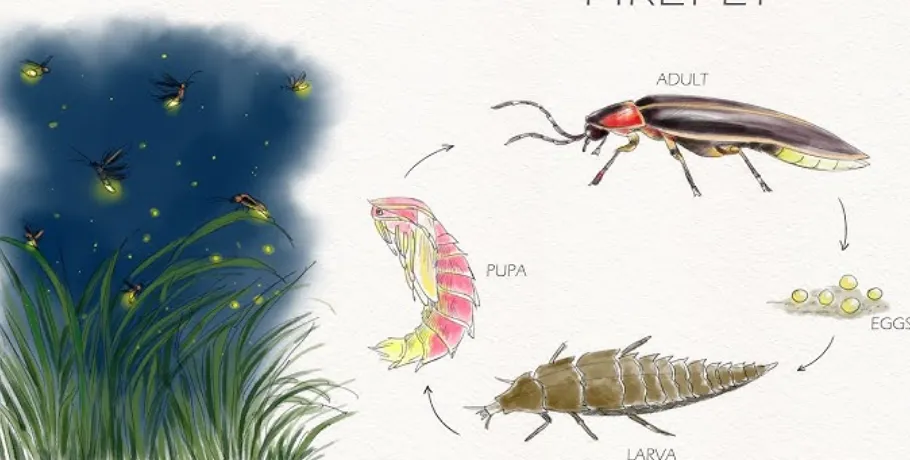
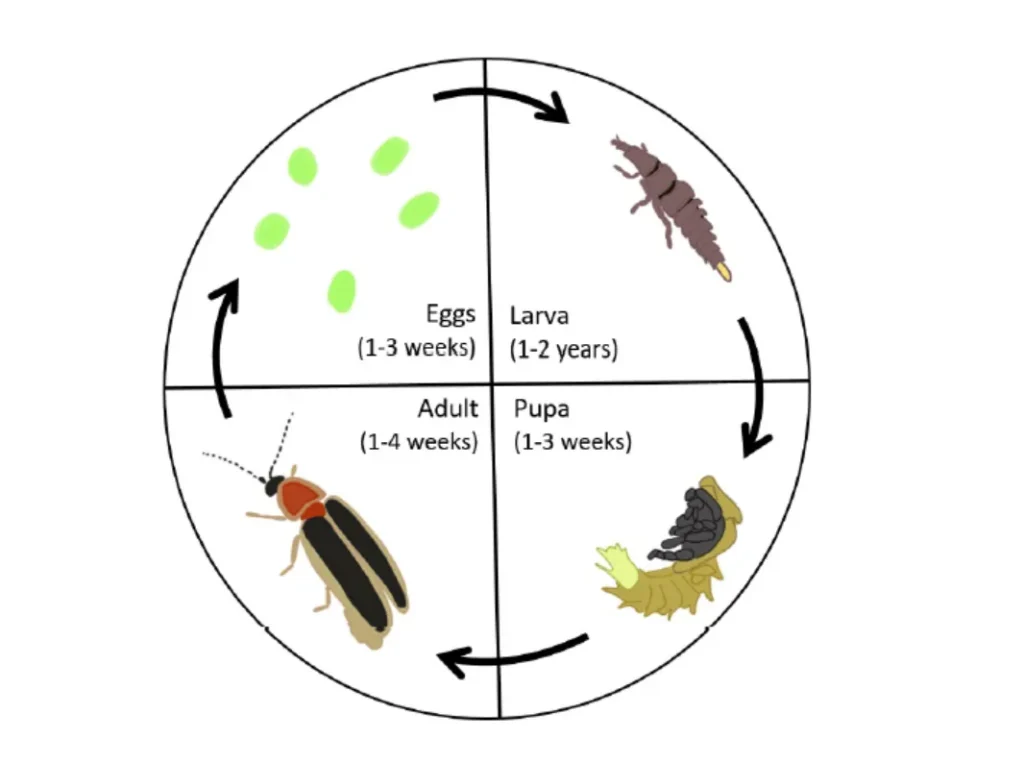
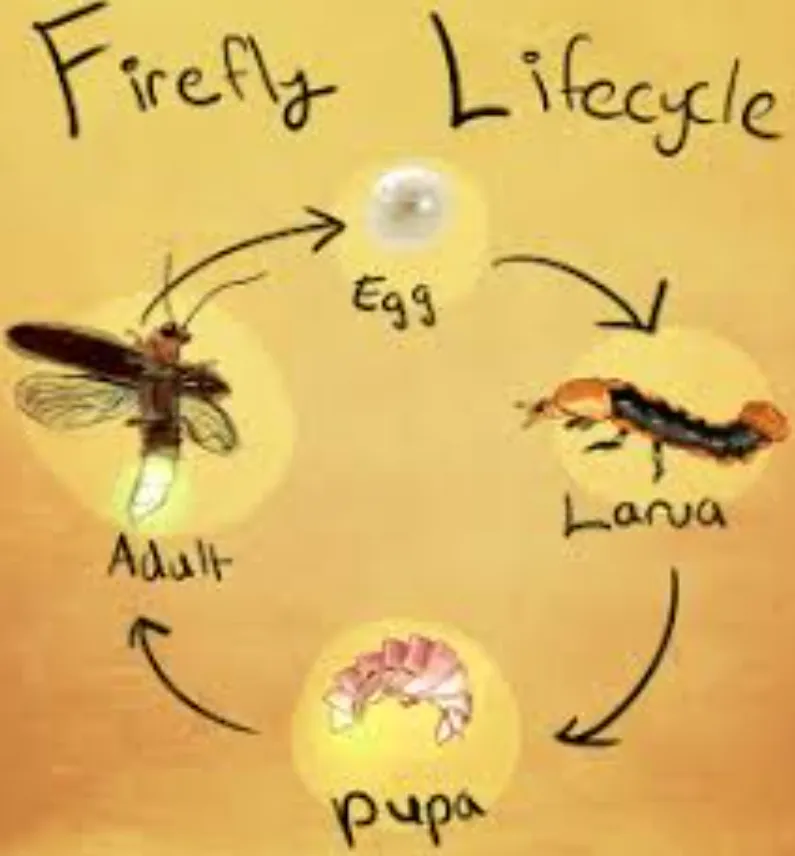
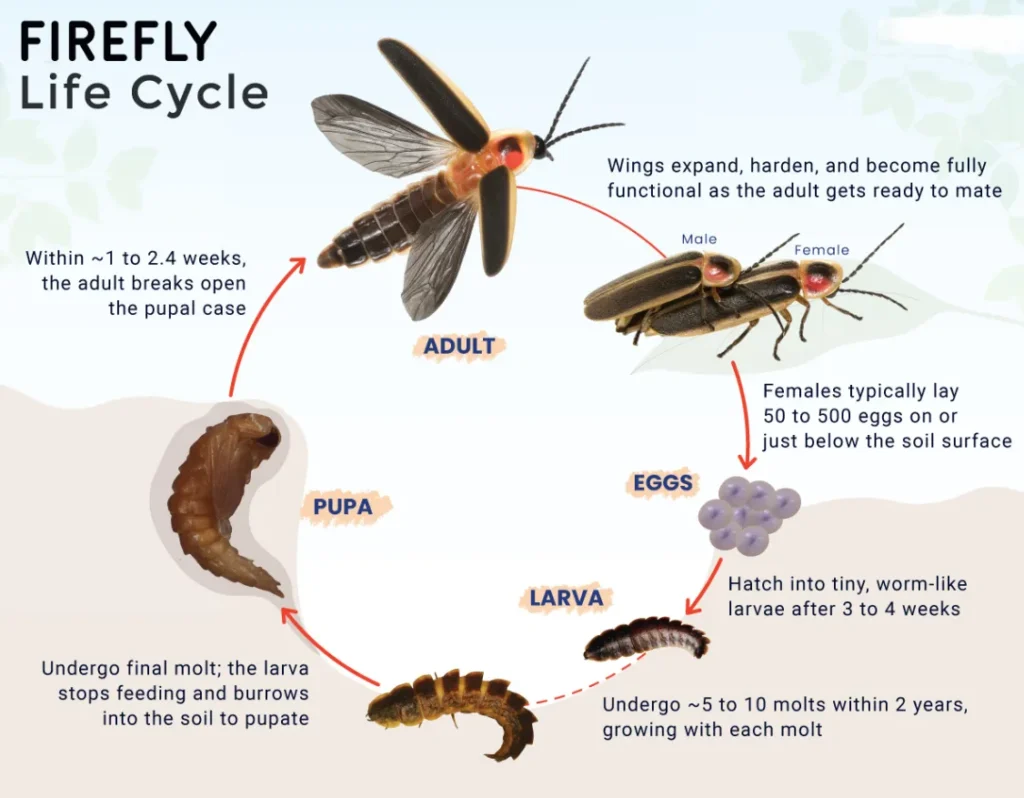
A lightning bug passes through four main life stages: egg, larva, pupa, and adult. This process is called complete metamorphosis. Most people notice only the adult stage because adults glow and fly in the evening. However, the larval stage is usually the longest and most important part of the lightning bug’s life cycle.
Lightning bugs live in moist environments such as gardens, wetlands, forests, grasslands, and areas with leaf litter. Their survival depends on moisture, darkness, soil health, and safe breeding places. Understanding the life cycle of a lightning bug helps us see why these glowing insects are important to nature and why they need protection.
Q: What is the life cycle of a lightning bug?
A: The life cycle of a lightning bug has four stages: egg, larva, pupa, and adult.
Q: Are lightning bugs and fireflies the same?
A: Yes. Lightning bug and firefly are two common names for the same insect group.
Q: What do lightning bug larvae eat?
A: Lightning bug larvae usually eat soft-bodied animals such as snails, slugs, worms, and small insects.
Quick Life Cycle Table
| Life Stage | Main Activity | Where It Lives | Approximate Duration | Key Feature |
| Egg | Development begins | Moist soil, moss, leaf litter, rotting wood | A few weeks | Some eggs may glow faintly |
| Larva | Feeding and growing | Damp soil, leaf litter, wetlands, under logs | Several months to two years or more | Main hunting stage |
| Pupa | Body transformation | Soil chamber, bark, vegetation, or leaf litter | Days to weeks | Changes into adult form |
| Adult | Mating and egg laying | Grass, shrubs, forest edges, meadows, gardens | Usually, a few weeks | Glowing and reproduction |
This table shows that the adult glowing stage is only one part of the lightning bug life cycle. The hidden larval stage is much longer and more important for survival.
The History of Their Scientific Naming
The scientific naming of the lightning bug is connected with beetle classification, natural history, and the study of glowing insects.
- Lightning bugs belong to the order Coleoptera, which includes beetles. This means they are not flies, even though many people call them fireflies.
- Their family name is Lampyridae. This family includes fireflies, lightning bugs, and glow-worms.
- The name Lampyridae is linked with the idea of shining or glowing. This name fits them because their most famous feature is the production of natural light.
- One well-known species is Photinus pyralis, commonly known as the common eastern firefly or big dipper firefly.
- The word Photinus is connected with light, while pyralis has a connection with fire-like meaning.
- Common names vary by region. Some people say lightning bug, while others say firefly.
- Scientific names are useful because they help researchers identify exact species based on body shape, flash pattern, habitat, and genetics.
The scientific naming of lightning bugs helps separate thousands of species that may look similar but behave differently in nature.
Their Evolution And Their Origin
The origin of the lightning bug goes deep into the evolutionary history of beetles. Fireflies are members of the large insect order Coleoptera, one of the most diverse insect groups on Earth. Their family, Lampyridae, includes thousands of species found in many parts of the world.
The most famous evolutionary feature of lightning bugs is bioluminescence. This is the ability to produce natural light through a chemical reaction inside the body. The glow is produced when luciferin, luciferase, oxygen, and energy molecules interact. The result is a cool light that produces very little heat.
Scientists believe that glowing first developed as a warning signal. Early lightning bug larvae may have used light to tell predators that they were unpleasant or chemically protected. This warning system likely helped them survive in dark, moist habitats where predators were active.
Over time, many adult lightning bugs began using light for communication and mating. This means the glow changed from a simple defence tool into a complex reproductive signal. In many species, males flash while flying, and females answer from grass, leaves, or low plants.
Their evolution also explains why not all lightning bugs behave the same way. Some species flash brightly. Some glow steadily. Some adults do not produce strong light at all. Some females can fly, while others are wingless or resemble larvae.
This variety shows how lightning bugs adapted to different climates, habitats, predators, and mating systems over millions of years.
Important Things That You Need To Know
When people search for life cycle lightning bug, they often also search for terms like lightning bug, lightning bug vs firefly, firefly vs lightning bug, lightning bug larvae, female lightning bug, and lightning bug life cycle. These related keywords help explain the insect more clearly.
The phrase lightning bug vs firefly usually creates confusion. In reality, both names refer to the same insect group. The difference is mostly in the regional language. In some places, people commonly say lightning bug. In other places, people say firefly. Scientifically, both refer to beetles in the family Lampyridae.
The terms firefly and lightning bug also have the same answer. There is no major biological difference between them. They are not flies and not true bugs. They are beetles with soft bodies and, in many species, glowing organs.
The keyword lightning bug larvae is very important because larvae spend the longest time in the life cycle. While adults are famous for glowing in the air, larvae live quietly near the ground. They hunt in moist soil, leaf litter, moss, and rotting wood.
A female lightning bug may behave differently from a male. In many species, males fly and flash to attract mates. Females often stay on plants or near the ground and respond with their own light signal. Some females have wings, while others have reduced wings or no wings.
The full life cycle of the lightning bug depends on moisture, darkness, soil cover, and a safe habitat. Without these natural conditions, lightning bug populations may decline.
Their main food and its collection process
The food habits of a lightning bug change from one life stage to another. The larval stage is the main feeding stage, while the adult stage is usually more focused on mating and reproduction.
- Larval food: Lightning bug larvae are predators. They commonly eat snails, slugs, worms, insect larvae, and other soft-bodied animals.
- Hunting place: Larvae hunt in damp soil, leaf litter, moss, wetland edges, under logs, and around decaying plant matter.
- Hunting method: Larvae use their strong mouthparts to catch prey. They may inject chemicals that paralyse the prey and aid its breakdown.
- Slow movement strategy: Larvae do not need to chase fast prey. They usually attack slow-moving animals such as snails and slugs.
- Importance of moisture: Damp environments help larvae move, hide, and find food. Dry soil makes survival difficult.
- Adult food: Adult lightning bugs may feed on nectar, pollen, or small amounts of liquid food. Some adults may eat very little.
- Predatory adults: In some species, females may attract males of other firefly species by copying their flash signals. After attracting them, they may eat them.
- Energy use: Larvae eat actively to store enough energy for pupation and adulthood.
The food-collection process of lightning bugs is useful to nature. By feeding on soft-bodied animals, they help control small invertebrate populations in gardens, wetlands, and forest floors.
Their life cycle and ability to survive in nature
Egg Stage
The life cycle of the lightning bug begins when a female lays eggs in moist, protected places. These places may include soil, moss, leaf litter, grass roots, or rotting wood.
Moisture is very important at this stage. If eggs dry out, they may fail to develop. Some lightning bug eggs may glow faintly, which may help with protection or warning.
Larval Stage
After hatching, the insect enters the larval stage. This is the longest and most active feeding stage of the lightning bug’s life cycle.
The larvae live close to the ground. They hide under leaves, in soil, among logs, and among damp plants. Their main job is to eat, grow, and store energy.
Pupal Stage
When the larva matures, it enters the pupal stage. During this stage, the body changes into the adult form.
The pupa may stay in soil, leaf litter, bark, or a small hidden chamber. This stage is quiet but very important because the insect is undergoing internal transformation.
Adult Stage
The adult stage is the most visible. Adult lightning bugs emerge to mate and lay eggs.
In many species, males fly and flash. Females wait on grass or leaves and reply with light. This light communication helps males and females find each other in the dark.
Natural Survival Ability
Lightning bugs survive by using moisture, darkness, chemical defence, hiding behaviour, and light signals. Larvae hide from predators near the soil. Adults use glowing signals for mating.
Their survival depends on clean habitat, reduced light pollution, and enough natural cover.
Their Reproductive Process and raising their children
The reproductive process of the lightning bug is closely linked to light communication. In many species, males and females use flashing signals to find each other.
- Male flashing: Male lightning bugs usually fly at night and produce flashing patterns. Each species may have its own flash rhythm.
- Female response: A female lightning bug often waits on grass, leaves, or low vegetation. If she accepts the signal, she flashes back.
- Flash timing: The timing between the male flash and the female response is important. It helps the male identify the correct mate.
- Courtship process: The male follows the female’s response until he reaches her location.
- Mating: After finding each other, mating takes place. The adult stage is short, so successful mating must happen quickly.
- Egg laying: After mating, the female lays eggs in moist and safe places.
- No direct parenting: Lightning bugs do not raise their young as mammals or birds do. They do not feed or guard the larvae after hatching.
- Choosing a safe habitat: The female supports the next generation by choosing a good egg-laying site with moisture, cover, and food nearby.
- Independent larvae: Once the eggs hatch, larvae survive on their own by hunting and hiding.
This reproductive process can be harmed by artificial light. Bright outdoor lighting may confuse mating signals, making it harder for males and females to find each other.
The importance of them in this Ecosystem
Natural Soil Predators
Lightning bug larvae play an important role as natural predators. They eat snails, slugs, worms, and other small soft-bodied animals.
This helps balance populations in the soil ecosystem. Even though lightning bugs are small, their feeding behaviour supports natural control in gardens, forests, and wetlands.
Part of the Food Web
Lightning bugs are also part of the food chain. Some birds, spiders, frogs, and other animals may try to eat them.
However, many lightning bugs have chemical protection. Their glow may warn predators that they are not good to eat.
Indicator of Healthy Habitat
A healthy lightning bug population can show that an area has good soil moisture, natural vegetation, leaf litter, and low chemical disturbance.
If lightning bugs disappear from an area, it may indicate habitat damage, pesticide use, light pollution, or poor soil conditions.
Scientific Importance
Lightning bugs are important in science because of their natural light chemistry. Their light-producing system involves luciferin and luciferase.
This natural process has helped researchers in biology, medicine, and laboratory studies. Firefly light has been used in scientific tools to study cells and chemical reactions.
Cultural and Natural Beauty
Lightning bugs also have emotional and cultural value. Their summer glow creates wonder, curiosity, and a strong connection with nature.
For many people, seeing lightning bugs is a childhood memory and a sign of a healthy, natural evening environment.
What to do to protect them in nature and save the system for the future
Lightning bugs are facing threats from habitat loss, artificial night lighting, pesticides, climate change, and loss of moist natural areas. Protecting them requires simple but meaningful actions.
- Reduce outdoor lighting: Turn off unnecessary garden, yard, porch, and pathway lights during firefly season.
- Use soft warm lights: If outdoor light is needed, use warm-coloured, low-intensity, shielded lights.
- Avoid pesticides: Chemical sprays can kill larvae, adults, and the small animals they eat.
- Keep leaf litter: Do not remove all fallen leaves. Leaf litter gives eggs and larvae shelter.
- Protect moist soil: Maintain damp garden areas, wetland edges, pond borders, and natural drainage spaces.
- Grow native plants: Native grasses, shrubs, and flowers create a better habitat for lightning bugs.
- Avoid over-mowing: Leave some grass longer so females and larvae have safe hiding places.
- Keep rotting logs and natural debris: Dead wood and moss can support larvae and prey.
- Limit firefly catching: Watching lightning bugs is fine, but keeping them trapped for too long can reduce mating chances.
- Create a dark garden corner: A pesticide-free, moist, low-light area can help support their life cycle.
- Protect wetlands and forest edges: These areas are important breeding and feeding zones.
- Teach children gently: Encourage children to observe lightning bugs without harming them.
Protecting lightning bugs means protecting the natural systems they depend on. When we save their habitat, we also support soil health, biodiversity, and nighttime ecosystems.
Frequently Asked Questions (FAQs)
Q: What is a lightning bug?
A: A lightning bug is a soft-bodied beetle from the family Lampyridae. It is also commonly called a firefly.
Q: What are the stages of the lightning bug life cycle?
A: The lightning bug life cycle has four stages: egg, larva, pupa, and adult.
Q: Is a lightning bug the same as a firefly?
A: Yes. Lightning bug and firefly are two common names for the same type of glowing beetle.
Q: What do lightning bug larvae eat?
A: Lightning bug larvae eat snails, slugs, worms, insect larvae, and other soft-bodied animals.
Q: Where do lightning bugs lay eggs?
A: Female lightning bugs usually lay eggs in moist soil, moss, leaf litter, grass roots, or rotting wood.
Q: Why do lightning bugs glow?
A: Lightning bugs glow through bioluminescence. This glow helps with warning, defence, and mating communication.
Q: Do female lightning bugs fly?
A: Some female lightning bug adults can fly, but others stay on vegetation or near the ground. Some species have females with reduced wings.
Q: How long do lightning bugs live?
A: The full life cycle may last from several months to two or more years, depending on the species and environment.
Q: Are lightning bugs harmful to humans?
A: No. Lightning bugs are not harmful to humans. They do not bite people aggressively and are generally safe to observe.
Q: Why are lightning bugs disappearing?
A: Lightning bugs may decline because of habitat loss, artificial light at night, pesticide use, climate change, and destruction of moist natural areas.
Conclusion
The life cycle of the lightning bug is a beautiful example of complete metamorphosis in nature. From tiny eggs hidden in moist soil to glowing adults flying through summer nights, every stage has a purpose. The egg stage begins life, the larval stage builds strength, the pupal stage transforms the body, and the adult stage continues reproduction.
A lightning bug is more than a glowing insect. It is a predator, a prey species, a scientific wonder, and a sign of a healthy environment. The lightning bug life cycle depends on darkness, moisture, natural soil, leaf litter, and safe breeding places.
Protecting lightning bugs does not require complicated work. Reducing outdoor lights, avoiding pesticides, keeping native plants, and protecting moist habitats can make a real difference.
When we protect lightning ugs, we protect natural darkness, soil life, biodiversity, and the quiet beauty of summer nights.
Also Read: life cycle in ferns