The life cycle of salmon is one of nature’s most powerful migration stories. A salmon begins as a tiny egg hidden under cold river gravel, grows through several fragile freshwater stages, adapts its body for saltwater, travels into the ocean, and later returns to its birthplace to reproduce. This journey is called anadromy, meaning the fish spends part of its life in freshwater and part in the sea. NOAA describes Atlantic salmon as a fish that begins life in rivers, migrates to saltwater to grow, and returns to freshwater to spawn.
Salmon are not just interesting fish. They support forests, bears, birds, marine mammals, river insects, and people. Pacific salmon are considered keystone species because their bodies carry ocean nutrients back into rivers and surrounding habitats after spawning.
Understanding salmon helps us understand river health, ocean conditions, food webs, climate pressure, and wildlife conservation. This article explains their naming history, origin, food habits, reproduction, survival skills, ecological value, and how we can protect them.
Quick Answers: Most Common Questions
Q: What are the main stages in the life cycle of salmon?
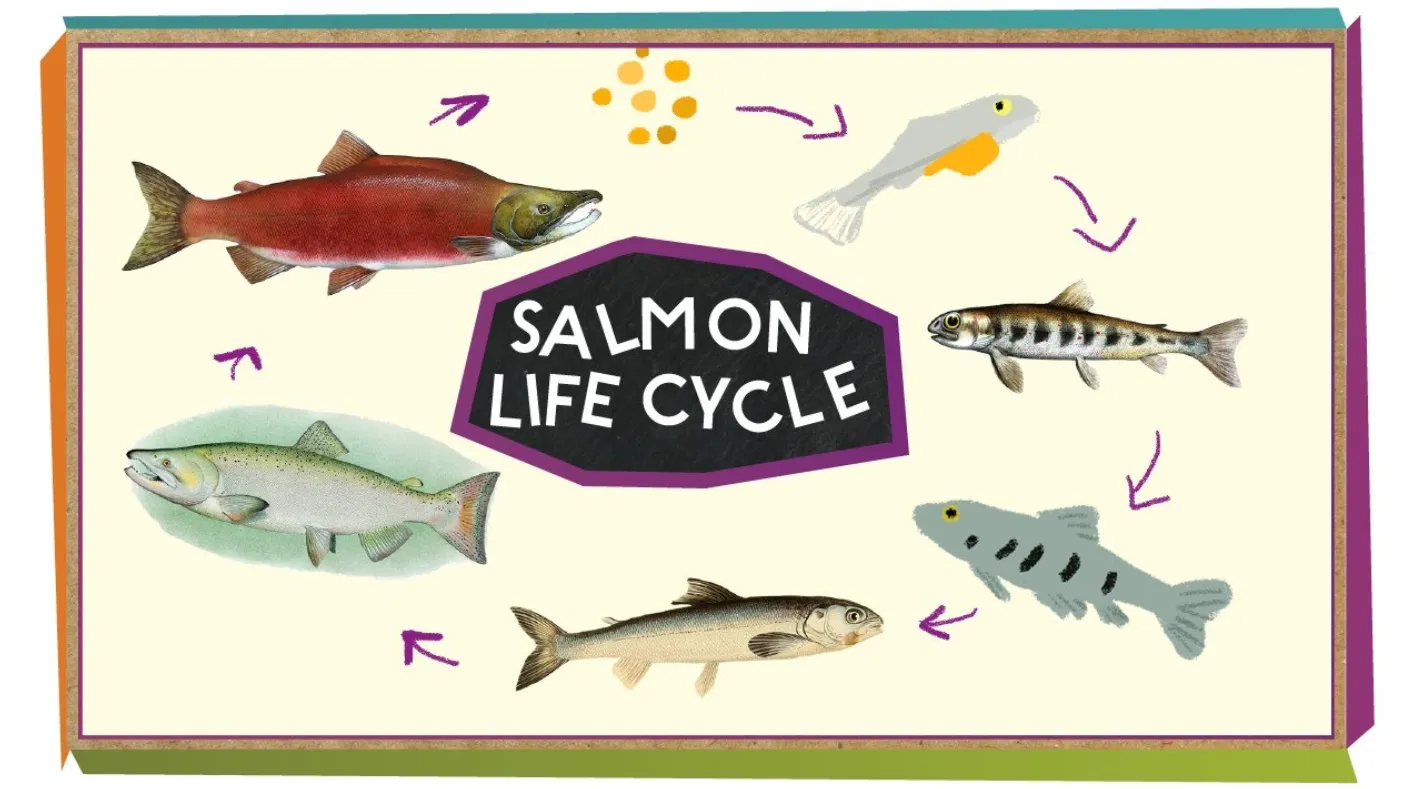
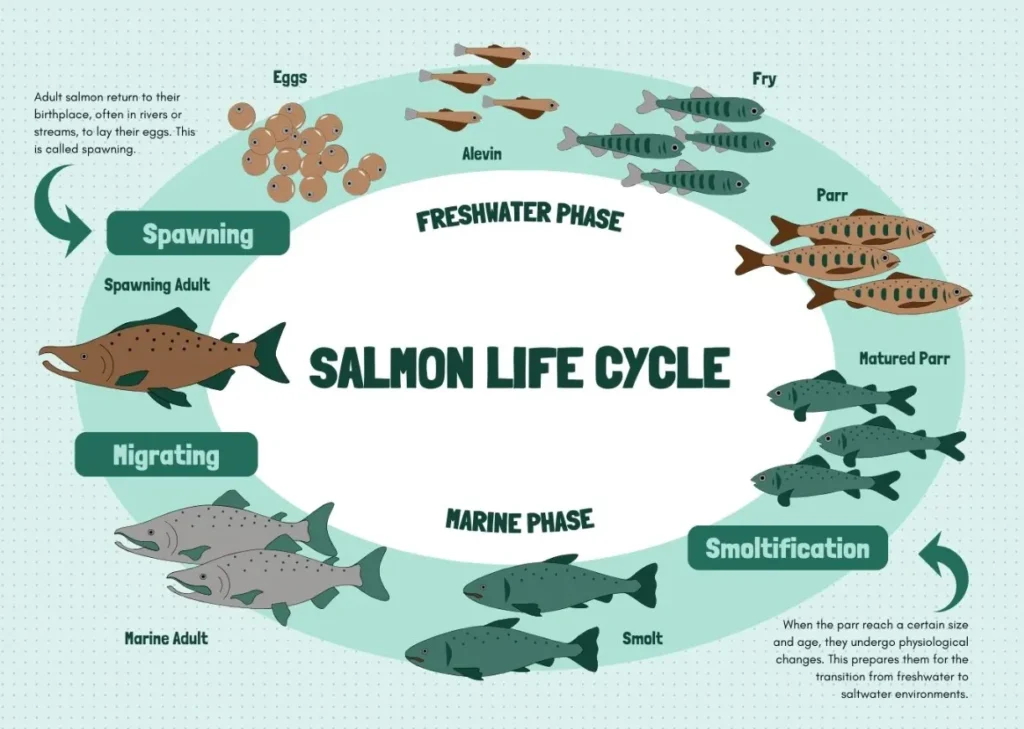
A: The main stages are egg, alevin, fry, parr, smolt, adult ocean salmon, and spawning adult. The exact timing depends on species and habitat.
Q: Why do salmon return to the river where they were born?
A: Salmon have strong natal homing behavior. They use smell, environmental memory, and migration cues to return to their birth stream for spawning.
Q: Do all salmon die after spawning?
A: Most Pacific salmon die after spawning, while some Atlantic salmon may survive and spawn again. Britannica notes that Pacific salmon usually die soon after spawning, but many Atlantic salmon can reproduce more than once.
Quick Life Cycle Table
| Life Stage | Habitat | What Happens | Main Survival Challenge |
| Egg | Freshwater gravel nest, called a redd | Eggs develop under river gravel during cold months | Floods, silt, low oxygen, and predators |
| Alevin | Hidden under gravel | Young salmon live from the yolk sac attached to the body | Staying hidden and avoiding disturbance |
| Fry | Shallow freshwater areas | They leave gravel and start feeding on tiny insects and plankton | Predators, weak swimming ability |
| Parr | Freshwater streams or lakes | They grow vertical marks called parr marks for camouflage | Competition for food and safe cover |
| Smolt | River mouth and estuary | Body changes to handle saltwater | Adapting to ocean salinity |
| Ocean Adult | Open ocean or coastal sea | Salmon feed heavily and grow strong | Predators, temperature change, food supply |
| Spawning Adult | Birth river or stream | Adults return, build nests, lay and fertilize eggs | Migration barriers, exhaustion, warm water |
The National Park Service explains that salmon eggs remain in gravel, hatch into alevins, then become fry after the yolk sac is used up. NOAA also notes that adult salmon spawn in freshwater, eggs are buried in redds, and many adult salmon provide nutrients to freshwater ecosystems after death.
The History of Their Scientific Naming
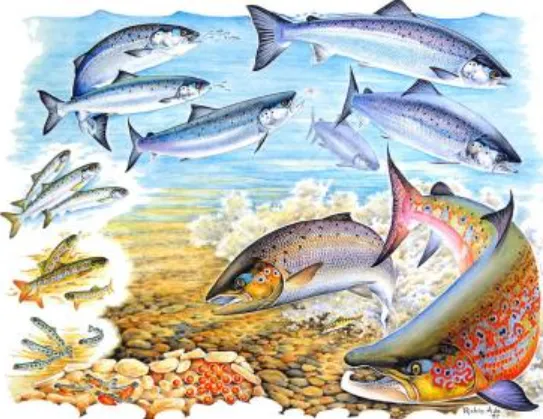
The word “salmon” is a common name, not a single scientific name. It is used for several species in the family Salmonidae, mainly from the genera Salmo and Oncorhynchus. Atlantic salmon belong to the genus Salmo, while Pacific salmon, such as sockeye salmon, coho salmon, pink salmon, and Chinook salmon, belong to the genus Oncorhynchus. Britannica lists the main Pacific salmon species under Oncorhynchus and identifies Atlantic salmon as Salmo salar.
Key naming points:
- Salmo salar is the scientific name of Atlantic salmon. FishBase explains that Salmo comes from Latin for salmon, while salar is linked with leaping behavior.
- Oncorhynchus is the genus name for Pacific salmon and trout. The name comes from Greek roots meaning “hooked snout,” referring to the hooked jaw many male salmon develop during spawning season.
- Sockeye salmon is scientifically named Oncorhynchus nerka. NOAA identifies sockeye as a Pacific salmon species, while NCBI lists Oncorhynchus nerka as the current scientific name with Salmo nerka as an older basionym.
- The names are more than labels. They help scientists separate species by origin, anatomy, migration pattern, and evolutionary relationship.
Their Evolution And Their Origin
The origin of salmon is tied to the wider history of the Salmonidae family, which includes salmon, trout, char, grayling, and whitefish. These fish are cold-water species, mostly linked with the Northern Hemisphere. Their evolution is important because salmon developed one of the most demanding life strategies in the fish world: moving between freshwater and saltwater while still returning to natal streams to reproduce.
A key fossil in salmon history is Eosalmo driftwoodensis, an ancient salmonid from the Eocene. Alaska Department of Fish and Game educational material identifies Eosalmo driftwoodensis as one of the earliest salmonid fossils, dating to about 50 million years ago. Scientific work on Eosalmo driftwoodensis describes it as a stem-group salmonine, meaning it had a mix of older and more modern salmon-like features.
Modern salmon did not appear all at once. Over millions of years, salmonid ancestors adapted to cold rivers, lakes, coastal waters, and eventually long migrations. Some populations became strongly anadromous, using rivers for birth and the ocean for growth. This gave them access to rich marine food, helping them grow larger before returning to spawn inland.
Evolution also shaped their body chemistry. The smolt stage is one of the clearest examples. During smoltification, young salmon undergo internal changes to survive in saltwater after living in freshwater. This ability gave salmon a huge advantage, but it also made them vulnerable to changes in both river and ocean environments.
Today’s salmon are the result of deep evolutionary pressure: predators, changing climates, shifting rivers, ocean food cycles, and the need to reproduce in clean, cold, oxygen-rich water.
Their main food and its collection process
Salmon food changes by age, species, and habitat. A young salmon in a stream does not eat the same food as a large adult salmon in the ocean. NOAA explains that young Atlantic salmon eat insects, invertebrates, and plankton, while larger adults mainly eat fish such as herring, alewife, smelt, capelin, sand lance, and small mackerel.
For sockeye salmon, NOAA notes that juveniles in freshwater feed mainly on zooplankton, amphipods, and insects. In the ocean, sockeye continue eating zooplankton but also consume larval fish, small adult fish, and sometimes squid.
Important feeding points:
- Egg stage: Salmon eggs do not collect food. They depend on nutrients stored inside the egg.
- Alevin stage: Alevins remain in the gravel and live from the attached yolk sac.
- Fry stage: Fry begin active feeding. They collect small insects, plankton, and tiny aquatic organisms near riverbanks.
- Parr stage: Parr feed more actively in freshwater, often catching drifting insects and small invertebrates carried by the current.
- Smolt stage: Smolts feed while moving toward estuaries, but survival depends on timing, body strength, and available prey.
- Ocean adult stage: Adult salmon hunt for richer food such as small fish, squid, crustaceans, and plankton.
Salmon do not “collect” food in a storage form like mammals do. Their food collection process involves active hunting and drifting to capture food. In rivers, they often face upstream and snap at prey moving with the current. In the ocean, they chase mobile prey and follow feeding zones where plankton, small fish, and marine invertebrates are available.
Food quality matters. NOAA reported in 2024 that winter larval fish indicators, used as a signal for future juvenile salmon prey, were the lowest in a 27-year time series in one ocean monitoring context. That kind of ocean food change can affect young salmon’s survival when they first enter the sea.
Important Things That You Need To Know
Many people search for salmon because they want to understand both the animal and the food. That is why related search terms like salmon recipes, baked salmon recipe, air fryer salmon, smoked salmon, how to cook salmon, and sockeye salmon often appear beside the keyword life cycle of salmon.
Still, there is an important difference between salmon as wildlife and salmon as food. Wild salmon are part of rivers, oceans, forests, and Indigenous cultural histories. Food salmon may come from wild fisheries or aquaculture, depending on the market and country.
Sockeye salmon is one of the best-known Pacific species because of its bright red spawning color and strong cultural and food value. Britannica describes sockeye salmon as Oncorhynchus nerka, a North Pacific food fish in the family Salmonidae.
When people search for how to cook salmon, they usually want kitchen advice. When they search for the life cycle of salmon, they want biology, ecology, and conservation. A strong article can address both search intents by carefully explaining that cooking terms are related to the core topic of salmon’s natural life journey.
For example, a person looking for an air fryer salmon dinner may later become curious about where salmon comes from. Someone searching for a baked salmon recipe may want to know whether sockeye salmon and Atlantic salmon are the same. They are not. Atlantic salmon is usually Salmo salar, while sockeye is Oncorhynchus nerka.
Understanding this difference helps readers make better choices as consumers and better decisions as citizens who care about rivers, oceans, and wildlife.
Their life cycle and ability to survive in nature
Egg Stage: Life Hidden in Gravel
The salmon life cycle begins when female salmon dig gravel nests called redds in cold freshwater streams. Eggs are laid in the gravel and fertilized by male salmon. Clean gravel is important because eggs need flowing, oxygen-rich water. If mud or pollution covers the gravel, eggs may suffocate.
Alevin Stage: Living from the Yolk Sac
After hatching, young salmon become alevins. They still carry a yolk sac, which works like a built-in food supply. At this stage, they are weak and stay hidden in gravel. The National Park Service explains that alevins remain close to the redd until the yolk sac is consumed.
Fry and Parr: Learning to Feed and Hide
Once the yolk sac is gone, the young fish become fry. They leave the gravel and begin feeding. Later, many become parr, marked by dark vertical bars that help them blend into stream shadows.
Smolt: Preparing for Saltwater
The smolt stage is one of the most important stages in survival. Salmon change color, body chemistry, and behavior to move from freshwater to saltwater. This transition is dangerous because estuaries contain predators, experience changing salinity, and experience shifting food supplies.
Adult Salmon: Growing in the Ocean
In the ocean, salmon grow larger by feeding heavily. If they survive predators, disease, fishing pressure, and changing ocean conditions, they later return to freshwater as spawning adults.
Their Reproductive Process and raising their children
Salmon reproduction is dramatic, exhausting, and closely tied to place. Adult salmon usually return to the river or stream where they were born. This return migration may involve long-distance swimming, waterfalls, predators, dams, low water, warm water, and physical exhaustion.
Main reproductive steps:
- Migration to natal water: Adult salmon leave the ocean and travel upstream toward their birth area.
- Physical change: Many salmon change color and shape. Male Pacific salmon often develop a hooked jaw called a kype.
- Nest building: The female uses her tail to dig a gravel nest called a redd.
- Egg laying: The female deposits eggs into the gravel.
- Fertilization: The male releases milt over the eggs.
- Covering the eggs: The female covers fertilized eggs with gravel to protect them.
- Post-spawning death or survival: Most Pacific salmon die after spawning, while some Atlantic salmon may survive and spawn again.
Salmon do not raise their children like birds or mammals. There is no feeding, guarding, or teaching after the eggs are buried. Instead, their parental care happens before hatching: choosing the right stream, selecting clean gravel, digging the redd, and covering the eggs.
In nature, this strategy works because each female lays many eggs. NOAA notes that female salmon lay thousands of eggs in freshwater spawning areas. Many eggs and young fish will not survive, but enough may live if habitat conditions remain healthy.
This is why river quality is so important. Salmon reproduction depends on cold water, clean gravel, oxygen flow, natural stream shape, and safe migration routes.
The importance of them in this Ecosystem
Salmon as Keystone Species
Salmon are often described as keystone species because many other organisms depend on them. NOAA explains that Pacific salmon support ecosystem health by feeding other species and moving ocean nutrients back into freshwater habitats.
This means salmon are not just fish. They are moving nutrient carriers.
Feeding Wildlife
Many animals eat salmon, including bears, wolves, eagles, otters, seals, sea lions, larger fish, and birds. NOAA notes that bears, wolves, river otters, and bald eagles may feed on adult pink salmon in freshwater spawning habitats.
When salmon return in large numbers, they create seasonal food pulses. Predators may eat only part of a fish and leave the rest near the river, where insects, microbes, plants, and scavengers use the nutrients.
Fertilizing Rivers and Forests
After spawning, dead salmon release nitrogen, phosphorus, and other nutrients. NOAA notes that salmon carcasses contribute valuable energy and nutrients to river ecosystems and can improve the growth and survival of newly hatched salmon.
This creates a cycle: adult salmon feed the river, the river feeds young salmon, and young salmon later return to the ocean.
Supporting Human Communities
Salmon are also important for food, jobs, culture, sport fishing, tourism, and Indigenous traditions. Their decline can damage local economies and cultural practices.
When salmon disappear, the loss moves through the whole system: rivers become poorer, predators lose food, and people lose a living connection to water.
What to do to protect them in nature and save the system for the future
Protecting salmon means protecting the full journey: river, estuary, coast, ocean, and spawning ground. A salmon can die at any point if one part of the system breaks.
- Protect cold, clean rivers: Salmon eggs and young fish need cold, oxygen-rich water. Reducing pollution, runoff, and sediment helps protect spawning gravel.
- Remove or improve migration barriers: Dams and blocked culverts can stop salmon from reaching spawning and rearing habitat. NOAA identifies barriers to migration as a major threat to Atlantic salmon because dams change natural river flow and block movement.
- Restore riparian vegetation: Trees along rivers shade the water, reduce erosion, and create habitat for insects that young salmon eat.
- Support smart water management: Low flows and warm water can make migration and egg survival harder. Water planning should protect streamflow during key salmon seasons.
- Reduce overfishing pressure: Harvest rules should match population health, species status, and long-term recovery goals.
- Protect estuaries: Estuaries are transition zones where smolts adjust to saltwater. Wetlands, tidal channels, and clean shorelines improve survival.
- Reduce climate pressures where possible: NOAA identifies climate threats to salmon populations, including hotter temperatures, changes in snowpack, shifts in freshwater quantity, flooding, sea level rise, and ocean acidification.
- Support science-based restoration: Habitat restoration, monitoring, and Indigenous-led river recovery projects can help rebuild salmon runs.
- Choose seafood responsibly: Consumers can learn where their salmon comes from and support responsibly managed fisheries or well-regulated aquaculture.
- Teach the salmon life cycle in schools: Public understanding creates long-term support for river protection and wildlife recovery.
In the United States, the Gulf of Maine Distinct Population Segment of Atlantic salmon is listed as endangered under the Endangered Species Act, showing how serious salmon decline can become when migration routes, river habitat, and ocean survival are damaged.
Frequently Asked Questions (FAQs)
Q: What is the life cycle of salmon?
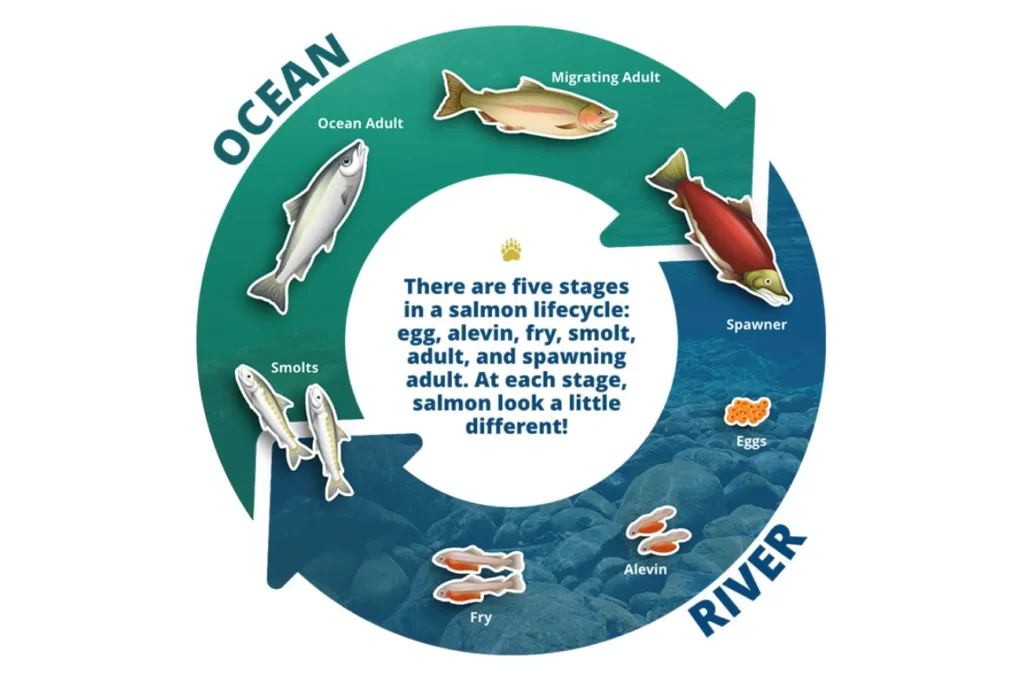
A: The life cycle of salmon includes egg, alevin, fry, parr, smolt, ocean adult, and spawning adult stages. Salmon hatch in freshwater, grow through early river stages, migrate to the ocean, then return to freshwater to reproduce.
Q: How long does the salmon life cycle take?
A: It depends on species and habitat. Some salmon complete the cycle in about two years, while others may spend several years in freshwater and the ocean before spawning.
Q: Why do salmon migrate to the ocean?
A: The ocean offers richer feeding opportunities. By feeding in marine waters, salmon can grow larger and stronger before returning to freshwater to spawn.
Q: What is a smolt?
A: A smolt is a young salmon that is changing from a freshwater fish into one that can survive in saltwater. This stage is essential for species that migrate to the ocean.
Q: What is a redd in the salmon life cycle?
A: A redd is a gravel nest made by a female salmon. She lays eggs in the redd, and the male fertilizes them before the female covers them with gravel.
Q: Are sockeye salmon and Atlantic salmon the same?
A: No. Sockeye salmon is Oncorhynchus nerka, a Pacific salmon species. Atlantic salmon (Salmo salar) is a species native to the Atlantic basin.
Q: What do salmon eat?
A: Young salmon eat insects, plankton, and small invertebrates. Adult salmon often eat small fish, squid, crustaceans, and other marine prey, depending on species and location.
Q: Why are salmon important to the Ecosystem?
A: Salmon feed many animals and carry ocean nutrients into rivers and forests. Their bodies help fertilize freshwater ecosystems after spawning, which supports young salmon and many other organisms.
Conclusion
The life cycle of salmon is a rare natural story that connects mountains, rivers, estuaries, oceans, forests, animals, and people. Salmon begin as eggs under gravel, grow through fragile young stages, transform into smolts, feed in the ocean, and return home to create the next generation. Their journey is beautiful, but it is also dangerous.
Salmon survival depends on clean water, open migration routes, healthy food webs, stable ocean conditions, and protected spawning habitat. When salmon decline, the damage does not stop with one fish species. Bears, eagles, forests, river insects, fishing communities, and future salmon all feel the loss.
Protecting salmon means protecting the whole system they travel through. If rivers stay cold, clean, and connected, salmon can keep returning. And when salmon return, they bring life back with them.
Also Read: life cycle of enterobiasis