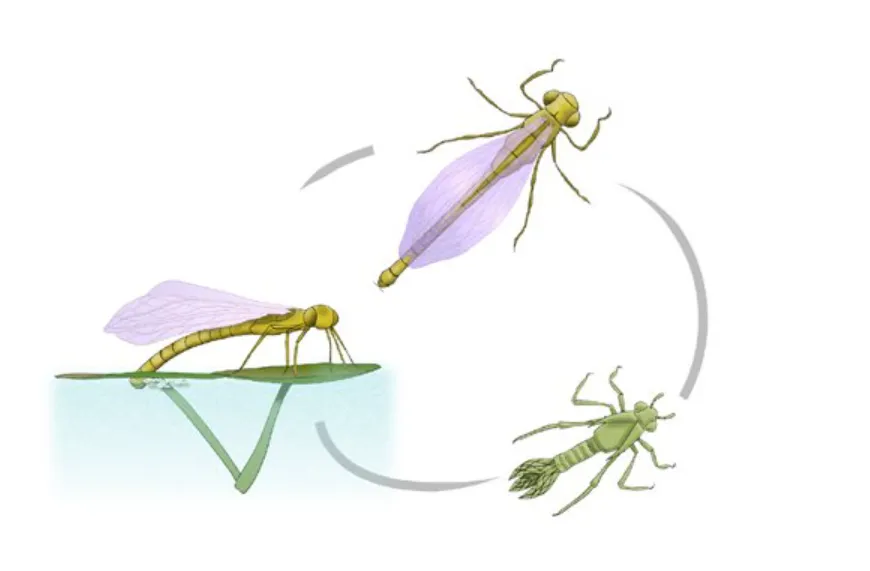
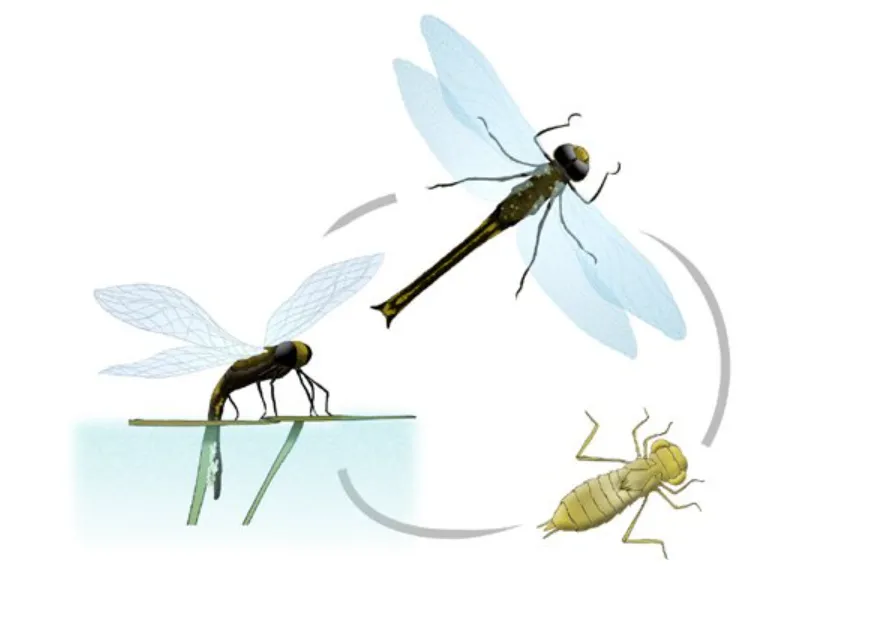
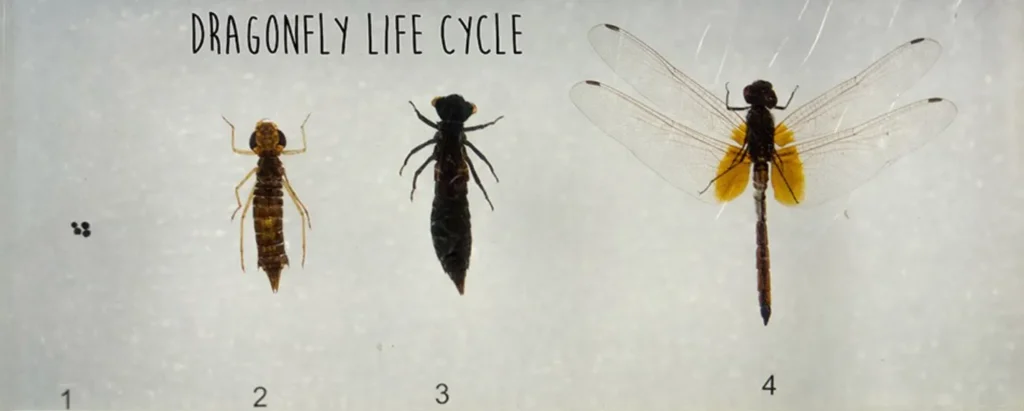
The life cycle of a dragonfly is one of the most fascinating natural transformations in the insect world. A dragonfly begins life in or near freshwater, grows underwater as a strong aquatic predator, and later emerges as a fast-flying adult insect. Unlike butterflies, dragonflies do not go through a pupal stage. Instead, they follow incomplete metamorphosis, moving from egg to larva and then directly into the adult stage.
Dragonflies are closely connected with ponds, rivers, wetlands, lakes, streams, and clean freshwater habitats. Their early life depends on water, which is why dragonflies are often seen near natural water bodies. The young stage, commonly called dragonfly larvae or nymphs, can live underwater for months or even years before becoming adults.
People also connect dragonflies with beauty, transformation, and balance. This is why topics such as dragonfly meaning, dragonfly spiritual meaning, dragonfly tattoo, dragonfly drawing, and dragonfly wellness are popular. Scientifically, however, dragonflies are important predators and valuable indicators of freshwater ecosystem health.
Q: What are the main stages in the life cycle of a dragonfly?
A: The main stages are egg, larva or nymph, emergence, and adult dragonfly.
Q: How long does a dragonfly live?
A: It depends on the species. Many dragonflies spend months to years underwater as larvae, while the adult stage may last only a few weeks or months.
Q: What do dragonfly larvae eat?
A: Dragonfly larvae eat mosquito larvae, worms, tadpoles, small Fish, crustaceans, and other small aquatic animals.
Quick Life Cycle Table
| Life Cycle Stage | Where It Happens | Main Activity | Key Feature |
| Egg | Water, plants, mud, or wet plant material | A female lays eggs | First stage of the dragonfly life cycle |
| Larva / Nymph | Underwater | Hunts, grows, and moults | Longest stage of life |
| Final Larval Stage | Shallow water edge | Prepares to emerge | Climbs out of the water |
| Emergence | Plant stems, rocks, or pond edges | The adult body comes out | No pupal stage |
| Young Adult | Near vegetation | Wings harden, and the body matures | Weak at first |
| Mature Adult | Around ponds, rivers, and wetlands | Hunts, mates, and lays eggs | Completes the cycle |
The History of Their Scientific Naming
The scientific naming of the dragonfly is connected with the insect order Odonata. This order includes both dragonflies and damselflies. The word Odonata comes from ancient Greek roots related to “toothed jaws,” referring to the strong mouthparts these insects use to catch and eat prey.
Dragonflies belong to the suborder Anisoptera. This name means “unequal wings.” It refers to the fact that many dragonflies have hindwings that are broader than their forewings. This wing structure helps them fly powerfully and control movement with impressive speed.
Important scientific classification:
- Kingdom: Animalia
- Phylum: Arthropoda
- Class: Insecta
- Order: Odonata
- Suborder: Anisoptera
Dragonflies are often confused with damselflies, but they are different. Dragonflies usually have larger bodies, stronger flight, bigger eyes, and wings that remain open when they rest. Damselflies are usually slimmer and often fold their wings above their bodies while resting.
Their Evolution And Their Origin
Dragonflies have a very ancient origin. Their relatives lived hundreds of millions of years ago, long before humans and many modern animals appeared. Ancient dragonfly-like insects were much larger than the dragonflies we see today. Some prehistoric relatives had wingspans of more than two feet, making them among the most impressive flying insects of ancient Earth.
Modern dragonflies are smaller, but they still retain many of the successful survival features of their ancient ancestors. Their large compound eyes, strong wings, fast flight, and predatory behaviour make them highly effective hunters. They can move quickly, change direction with control, and catch prey in the air.
The origin of dragonflies is closely linked to freshwater habitats. Even today, the life cycle of a dragonfly depends on water. Eggs are laid in or near water, larvae grow underwater, and adults return to water bodies for mating and egg-laying.
This connection between water and air makes dragonflies unique. They spend their early life as aquatic predators and their adult life as aerial hunters. This dual lifestyle enables them to play an important role in both aquatic and terrestrial food chains.
Their long evolutionary history also shows how successful their body design is. While many ancient species disappeared, dragonflies survived by adapting to diverse freshwater environments worldwide.
Their main food and its collection process
Dragonflies are carnivorous insects. This means they eat other animals. Both the larval and adult stages are predatory, though their food sources differ depending on where they live.
During the larval stage, dragonfly larvae live underwater and hunt small aquatic animals. They use a special extendable mouthpart called the labium to catch prey quickly. This mouthpart shoots forward and grabs small animals before they can escape.
Main food sources of dragonfly larvae include:
- Mosquito larvae
- Aquatic worms
- Small crustaceans
- Tadpoles
- Small Fish
- Other insect larvae
- Small snails
- Sometimes, smaller dragonfly larvae
Adult dragonflies hunt in the air. They use their excellent eyesight to follow moving prey. Their legs form a basket-like shape that helps them catch flying insects while flying.
Adult dragonflies commonly eat:
- Mosquitoes
- Flies
- Midges
- Small moths
- Butterflies
- Flying ants
- Smaller dragonflies
Their food collection process is fast and accurate. A dragonfly usually spots prey with its large compound eyes, flies toward it, catches it with its legs, and then eats it either while flying or after landing on a perch.
This feeding habit makes dragonflies useful in nature, as they help control insect populations.
Their life cycle and ability to survive in nature
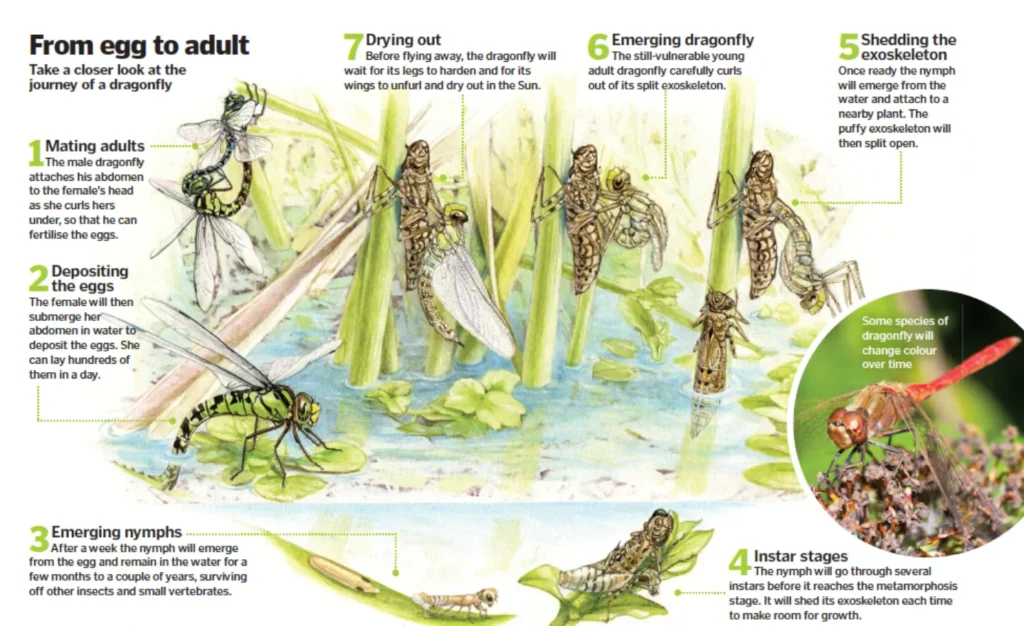
Egg stage
The life cycle of a dragonfly begins with eggs. Female dragonflies lay eggs in water, on aquatic plants, in wet mud, or near the edge of freshwater habitats. Some species insert eggs into plant tissues, while others drop eggs directly into water.
The egg stage is delicate because it depends on moisture, temperature, and protection from predators. If the water dries too quickly or becomes polluted, many eggs may not survive.
Larval stage
After hatching, the young dragonfly becomes a larva, also called a nymph or naiad. This stage happens underwater and is usually the longest part of the dragonfly’s life.
The larva survives by hiding among aquatic plants, mud, stones, roots, and debris. It is an active predator and catches small aquatic animals. As it grows, it moults several times by shedding its outer body covering.
Emergence stage
When the larva is fully grown, it moves toward the water surface. It climbs onto a plant stem, rock, or other support near the water. Then the adult dragonfly slowly emerges from the old larval skin.
This empty skin is called an exuvia. At first, the new adult is soft, pale, and weak. Its wings need time to expand, harden, and dry before it can fly.
Adult stage
The adult dragonfly is the flying stage. It hunts insects, avoids predators, finds a mate, and returns to water to lay eggs. Adult dragonflies survive through speed, sharp vision, strong flight, and quick reaction.
Their ability to live in both water and air makes them highly adaptable. However, they still need healthy freshwater habitats to complete their life cycle successfully.
Their Reproductive Process and raising their children
Dragonflies have a unique reproductive process. Males often defend territories around ponds, rivers, wetlands, and lakes. These territories are important because females visit water bodies to mate and lay eggs.
The male dragonfly first transfers sperm to a secondary reproductive structure on his abdomen. During mating, he holds the female behind the head using claspers at the end of his body. The female bends her abdomen forward to receive sperm. This creates a special shape often called the wheel position.
Important points about dragonfly reproduction:
- Males may defend breeding territories near water.
- Females select suitable places for laying eggs.
- Eggs may be placed in water, plants, mud, or wet surfaces.
- Some males guard females while they lay eggs.
- Larvae hatch and live independently.
- Dragonflies do not provide direct parental care after egg-laying.
Dragonflies do not raise their children like birds or mammals. The parents do not feed, protect, or teach the young after the eggs are laid. Instead, the female’s choice of egg-laying site is the most important form of care.
A clean pond, river, stream, or wetland gives the larvae a better chance of survival. The habitat provides food, hiding places, oxygen, and safe areas for growth.
Important Things That You Need To Know
The dragonfly is not only a beautiful insect. It has scientific, cultural, artistic, and symbolic importance. Many people search for the meaning of dragonflies because the insect is often associated with transformation, maturity, freedom, and change.
The dragonfly’s spiritual meaning is often associated with emotional growth, self-realisation, balance, and new beginnings. This symbolic idea comes from the insect’s dramatic transformation from underwater dragonfly larvae to a flying adult. Although this meaning is not a scientific fact, it shows how strongly humans associate nature with their personal lives.
The idea of dragonfly wellness is also used in lifestyle, meditation, yoga, and mental balance topics. In this sense, the dragonfly represents lightness, calm movement, clarity, and adaptation. It does not mean the insect provides medical wellness, but it is used as a natural symbol of peace and renewal.
A dragonfly tattoo is popular because it can represent survival, beauty, freedom, growth, and personal transformation. Many people choose dragonfly tattoos after major life changes.
A dragonfly drawing is also common in art, biology education, nature journals, tattoo design, and children’s learning. Drawing a dragonfly helps people notice its large eyes, long body, four wings, and delicate wing veins.
From a biological point of view, the most important thing to understand is that dragonflies depend on freshwater habitats. Their beauty in the air begins with healthy water below the surface.
The importance of them in this Ecosystem
Natural insect control
Dragonflies help control insect populations naturally. Both larvae and adults are predators. Larvae eat mosquito larvae and other aquatic animals, while adults eat mosquitoes, flies, midges, and other flying insects.
This makes dragonflies helpful in reducing some insect populations. They are not a complete solution for mosquito control, but they are an important part of the natural balance.
Food for other animals
Dragonflies are also food for many animals. Birds, frogs, Fish, spiders, reptiles, and larger insects may eat them. Fish, water birds, and other aquatic predators can also eat their larvae.
This makes dragonflies important in the food chain. They act as both predator and prey.
Indicator of freshwater health
Dragonflies are often linked with freshwater quality. Since their larvae live underwater, they are affected by pollution, oxygen levels, water temperature, and aquatic vegetation.
A healthy dragonfly population can suggest that a freshwater habitat is supporting life properly. A sudden decline may indicate habitat damage, pollution, or ecological imbalance.
Support for biodiversity
Dragonflies connect aquatic and land ecosystems. Their larvae live in water, while adults fly over land, gardens, wetlands, forests, and fields.
This movement helps transfer energy between different parts of the Ecosystem. It also supports biodiversity by linking water-based and air-based food webs.
Educational and cultural value
Dragonflies are useful for teaching life cycles, adaptation, metamorphosis, freshwater ecology, and conservation. They also inspire art, jewellery, photography, poetry, tattoos, and nature-based designs.
What to do to protect them in nature and save the system for the future
Dragonflies face threats from wetland loss, water pollution, pesticide use, climate change, and habitat destruction. Protecting dragonflies means protecting freshwater systems that support many other forms of life.
To protect dragonflies and their Ecosystem, we should:
- Protect ponds, rivers, lakes, wetlands, and streams from destruction and pollution.
- Avoid using harmful pesticides near gardens, farms, ponds, and water bodies.
- Plant native vegetation around freshwater habitats to provide shelter and egg-laying sites.
- Keep pond edges natural rather than covering them with concrete or artificial borders.
- Reduce water pollution by controlling plastic waste, sewage, oil, fertilisers, and chemical runoff.
- Create small wildlife ponds in gardens, schools, parks, and community spaces.
- Avoid removing all aquatic plants, because larvae need hiding places and adults need resting areas.
- Protect wetlands from uncontrolled urban development and industrial damage.
- Support dragonfly observation and citizen science projects to record local species.
- Teach children about dragonflies so future generations understand the importance of freshwater conservation.
- Maintain shallow pond edges, because larvae need safe places to emerge as adults.
- Protect natural water cycles by conserving trees, wetlands, and green spaces.
Saving dragonflies is not only about protecting one insect. It is about saving the freshwater habitats that support Fish, frogs, birds, plants, insects, and people.
Frequently Asked Questions (FAQs)
Q: What is the life cycle of a dragonfly?
A: The life cycle of a dragonfly includes egg, larva or nymph, emergence, and adult stages. Dragonflies follow incomplete metamorphosis, so they do not have a pupal stage.
Q: How long does a dragonfly stay as a larva?
A: A dragonfly can stay as a larva for several months to several years, depending on species, climate, food, and water conditions.
Q: What is dragonfly larvae?
A: Dragonfly larvae are the early aquatic stage of dragonflies. They live underwater, hunt small aquatic animals, and grow by moulting.
Q: Do dragonflies bite humans?
A: Dragonflies are not aggressive toward humans. They do not sting or have venom. A large dragonfly may bite only if handled roughly.
Q: What do dragonflies eat?
A: Adult dragonflies eat flying insects such as mosquitoes, flies, midges, moths, and smaller dragonflies. Larvae eat mosquito larvae, worms, tadpoles, crustaceans, and small Fish.
Q: Why are dragonflies found near water?
A: Dragonflies are found near water because their eggs and larvae need freshwater habitats. Adults also return to water for mating and egg-laying.
Q: What is the dragonfly spiritual meaning?
A: The dragonfly spiritual meaning is usually linked with transformation, change, freedom, emotional growth, and clarity.
Q: Why are dragonfly tattoos popular?
A: A dragonfly tattoo is popular because it can represent beauty, survival, freedom, personal growth, and transformation.
Conclusion
The life cycle of a dragonfly is a powerful example of transformation in nature. From tiny eggs to underwater dragonfly larvae, and from silent aquatic hunters to colourful flying adults, dragonflies show how closely life depends on clean water, healthy habitats, and ecological balance.
Their journey is not only beautiful but also useful. Dragonflies control insects, feed other animals, indicate freshwater quality, and connect aquatic and land ecosystems. They also inspire human culture through dragonfly meanings, dragonfly spiritual meanings, dragonfly tattoos, dragonfly drawings, and wellness symbolism.
Protecting dragonflies means protecting ponds, wetlands, rivers, lakes, and the many living systems connected to them. When dragonflies thrive, it often means nature is working well. Their survival reminds us that even a small insect can carry a big message about balance, resilience, and the future of our environment.
Also Read: life cycle of a bird